
Turn the material brief into a field garment
Engineer the details where technical apparel succeeds or fails.
Technical construction connects seam geometry, opening design, component choice, mobility and documentation. We review these decisions against the approved article and use case rather than treating one feature as proof of the whole garment.
Product-development visualization. Specifications and evidence follow the approved brief.
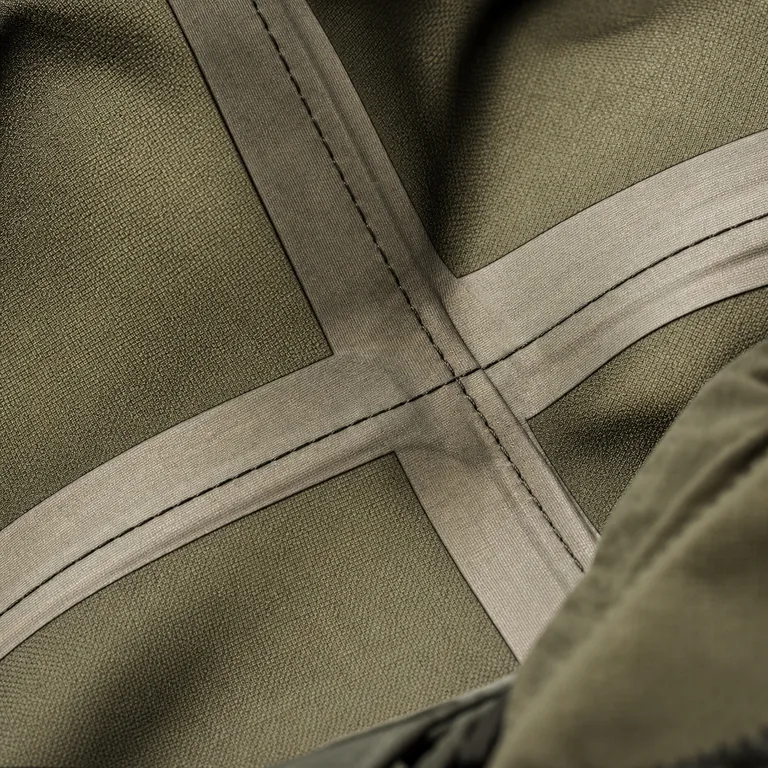
Seam sealing by design
Match seam geometry, tape and application to the selected laminate.
Seam sealing is developed where the chosen material and performance brief require it. Full or critical-area approaches need an explicit seam map, compatible tape route, application parameters and representative sample review.
What the buyer should prepare
Identify every seam and penetration that affects the agreed protection strategy.
Review seam allowance, bulk and curvature before tape application.
Confirm tape compatibility on the exact laminate and conditioned article.
Document approved application settings and inspection points.
Validate the finished garment when the market claim depends on complete construction.
Control likely ingress and failure points
Treat openings and hardware as part of the protection system.
Zippers, pocket entries, hood adjustments, cuffs and hems create functional access and construction risk. Water-repellent components do not make an opening watertight on their own.
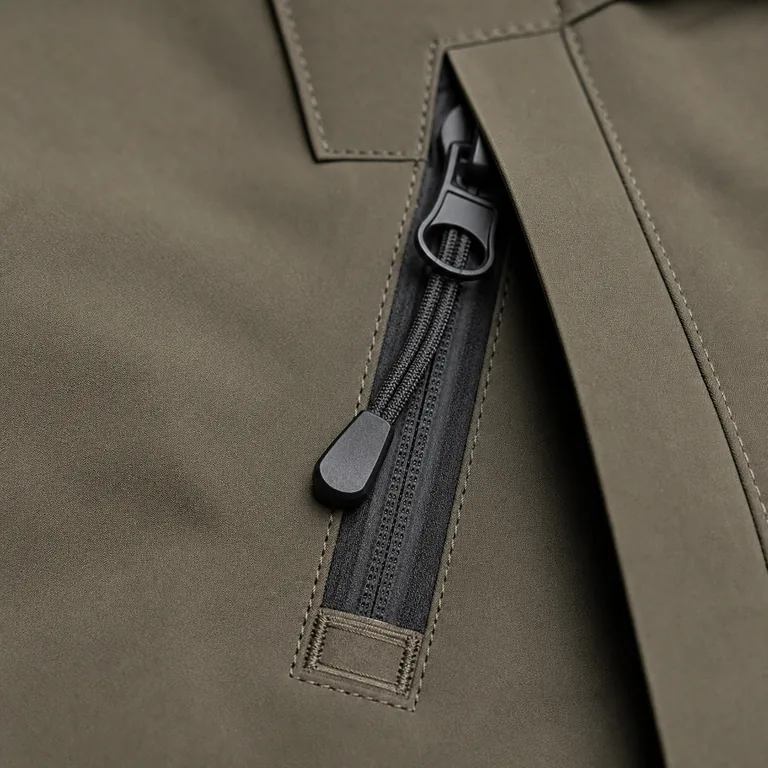
Protected openings
Use garages, flaps, drainage, placement and seam strategy according to exposure and access needs.
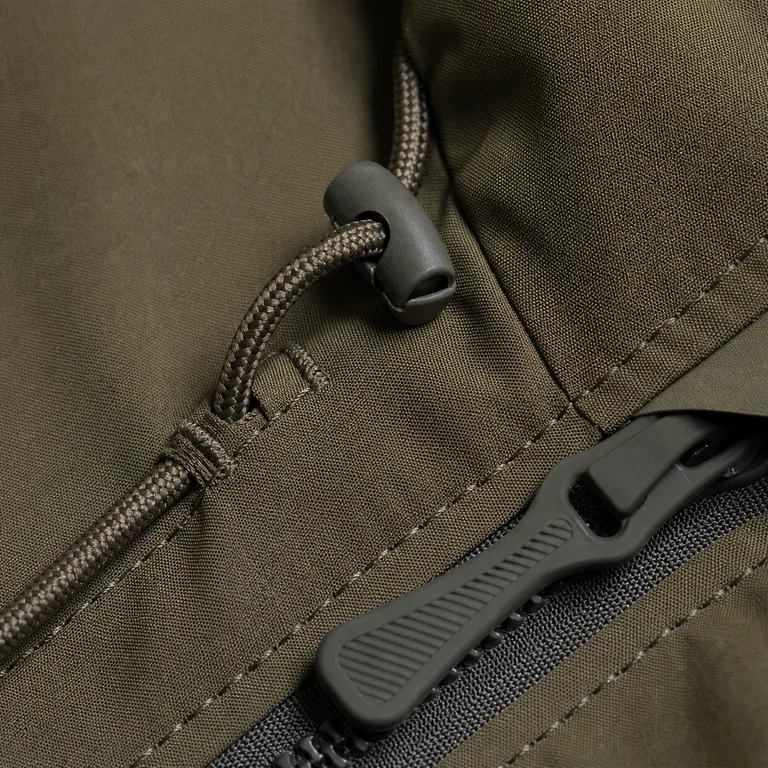
Quiet hardware
Compare operating sound, glove use, cord management, pull security and durability in the intended garment.
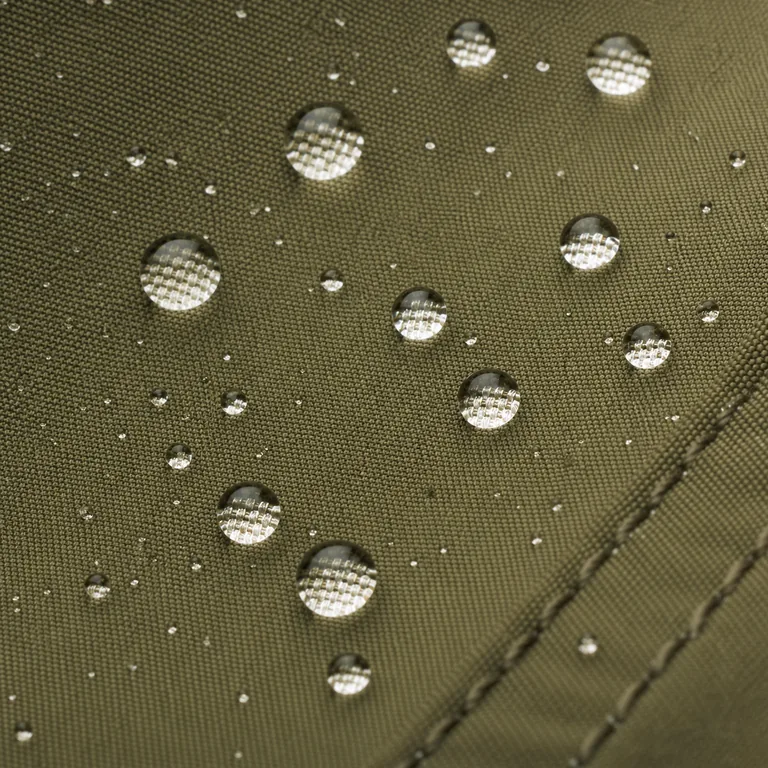
Surface repellency
Use DWR as a surface water-shedding measure, not a substitute for a waterproof barrier or sealed construction.
Fit is a technical feature
Pattern for the positions the hunter actually uses.
Articulation, gussets and ease must be assessed with the intended underlayers and equipment. A static standing fit is not enough for climbing, kneeling, shouldering or drawing a bow.

Range of motion
Check overhead reach, draw, climb and rotational movement without hem lift or restrictive load points.
Ready positions
Review kneeling, seated, shouldering and bow positions with the intended layers worn.
Pack and harness zones
Map straps and belts against pocket access, seam placement, insulation and abrasion zones.
Build only where needed
Balance durability, bulk and sound by zone.
Reinforcement and bartacks should respond to known loads. Low-noise design also depends on fabric-on-fabric contact, component movement, loose cords and access motions—not only the shell fabric.
What the buyer should prepare
Map abrasion and load zones from the pursuit and equipment brief.
Keep reinforcement edges out of repeated flex points where possible.
Control loose hardware and cord movement.
Compare pocket, zipper and hood operation in quiet-use scenarios.
Record repair-critical components and construction details for repeat orders.
Execution control
Lock construction decisions into the production package.
Approved seam maps, component references, stitch and reinforcement details, measurement tolerances and test responsibilities need one controlled source. Substitutions and revisions should be visible and approved before they enter production.
Risk review
Identify protection, mobility, sound and load risks in the design and tech pack.
Decision outputConstruction-risk list
Representative build
Prototype critical seams, openings, hardware and movement zones in the intended materials.
Decision outputApproved construction sample
Document
Lock seam maps, components, tolerances, checkpoints and permitted alternatives.
Decision outputControlled technical package
Verify
Inspect the approved production article against the agreed package and evidence plan.
Decision outputQuality and approval records
Project questions
Frequently asked questions
Answers specific to construction development.
Not every brief is the same. The sealing strategy depends on the material construction, garment design, exposure, intended claim and agreed validation method. The seam map should be approved explicitly.
No. Water-repellent zipper constructions can help manage surface exposure, but opening design, flaps, garages, seams and the complete garment determine the final protection strategy.
Yes. OEM support can begin with a review of materials, seam geometry, components, tolerances, movement zones and test requirements before sampling scope is confirmed.
The team can define a comparison protocol covering fabric contact, closures, cords, pockets and representative movement. Any public quietness claim still needs an agreed benchmark and evidence plan.
Next development gate
Review Construction Requirements
Share the product mission, target customer and known requirements for your hunting wear construction review. We will use them to frame the next technical conversation.