Eight controlled stages
Move from hunting mission to production-ready decisions.
The process makes buyer inputs, development outputs and approval gates visible. It can support an ODM range created from a brief or an OEM program beginning with an existing tech pack.
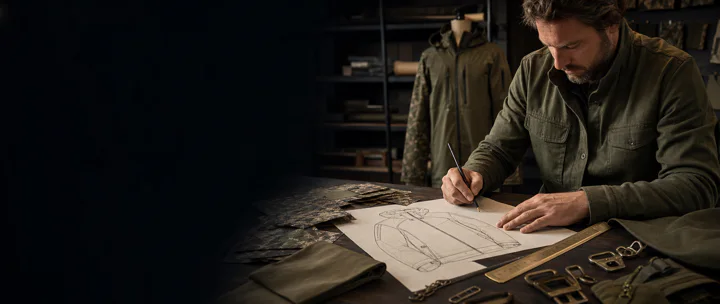
Product-development visualization. Specifications and evidence follow the approved brief.
The complete workflow
Each stage produces a decision—not just activity.
The workflow is designed to prevent unresolved assumptions from moving downstream. Exact deliverables are confirmed for the project, but every stage should have an owner, reference and approval state.
Discover
Define customer, pursuit, conditions, commercial context and current development inputs.
Decision outputMission brief
Define
Map the range, product jobs, requirements, constraints and approval responsibilities.
Decision outputSystem requirements
Design
Develop or review concepts, fit, material architecture, construction and claim intent.
Decision outputDevelopment specification
Develop
Build representative prototypes and resolve material, pattern and construction questions.
Decision outputPrototype and revision log
Test
Evaluate agreed material, construction, fit and claim risks in the defined state.
Decision outputResults and observations
Validate
Approve fit, function, documents, evidence and controlled production references.
Decision outputApproval pack
Produce
Execute against the approved package with defined checkpoints and change control.
Decision outputProduction and quality records
Support
Manage approved corrections, reorder references and continuous product decisions.
Decision outputControlled post-launch record
Stages 1–2
Resolve the product job before designing the solution.
Discovery identifies the user, mission, market and business context. Definition converts that information into a product or range architecture with explicit priorities, unknowns and approval owners.
What the buyer should prepare
What the end user is doing and in which conditions.
Which products are in scope and how they work together.
What the brand already owns: references, artwork, blocks, tech packs or samples.
Which claims or requirements need evidence.
Which decisions belong to the brand, SSM or a third party.
Stages 3–4
Turn requirements into a representative physical build.
ODM work may create concepts and specifications, while OEM work may review and adapt an existing package for manufacturability. In both cases, critical materials, constructions, fit positions and interfaces need physical confirmation.
Design decisions
Silhouette, fit, product features, material architecture, construction and branding route.
Prototype questions
Critical seams, openings, movement, layer compatibility, print placement and component operation.
Revision control
One visible record of what changed, why it changed and which sample replaces the previous reference.
Stages 5–6
Connect evaluation to approval.
Testing is useful only when its output changes a decision. Validation combines fit, function, construction, evidence, artwork and documents into an approved package suitable for production handover.

What the buyer should prepare
Confirm the exact sample and conditioning state under review.
Record fit and movement observations by approved size and layer combination.
Link test or comparison results to the claim and decision they support.
Close or explicitly accept every open deviation.
Identify the approved sample and document versions for production.
Stages 7–8
Protect the approved intent through production and reorders.
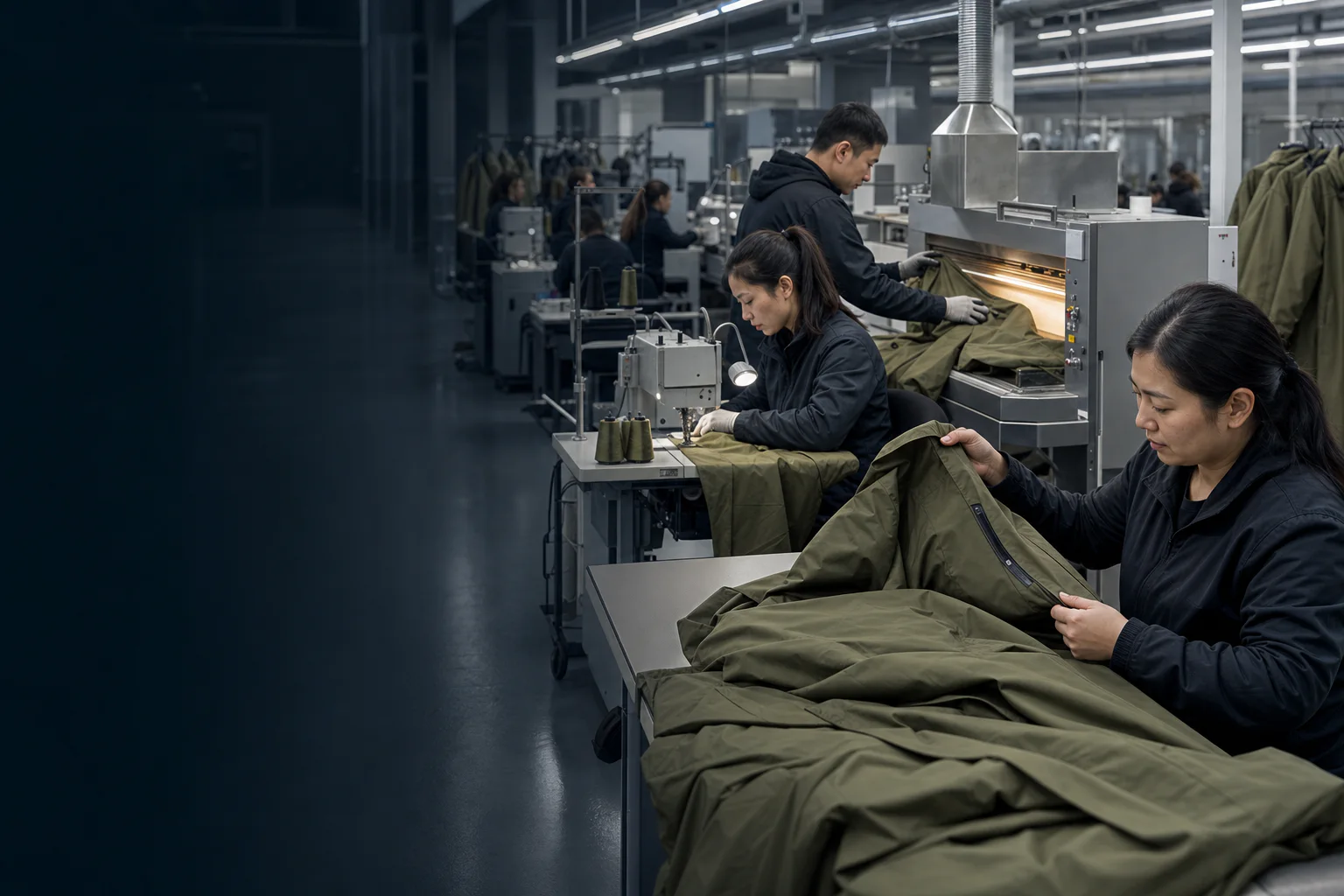
Production begins from the controlled package, not from an early concept. Quality checkpoints, substitutions and deviations should be managed against the approved references, with post-launch learning captured for future runs.
Controlled handover
Approved BOM, patterns, measurements, artwork, construction, samples and evidence responsibilities.
Change approval
No material, component, artwork or construction substitution should be treated as silent equivalence.
Reorder continuity
Preserve approved references and record justified changes so repeat orders start from known decisions.
Project questions
Frequently asked questions
Answers specific to development process development.
Every program should address the decisions represented by the stages, but the depth differs. A mature OEM package may shorten early design work, while an ODM range needs more discovery and definition.
Commercial terms are confirmed after sufficient product, material, quantity, sample and program information is available for a responsible review.
Approval roles should be agreed at discovery. The brand normally approves the commercial product, while SSM documents manufacturability and production references within the agreed scope.
The proposed change, reason, affected documents, evidence impact and approval owner should be recorded before the controlled package is updated.
Next development gate
Start with Discovery
Share the product mission, target customer and known requirements for your hunting wear development discovery. We will use them to frame the next technical conversation.