Establish the record hierarchy
Identify the latest approved tech pack, BOM, measurement chart, artwork, shade, sample, test request, packaging instruction, and change history.
Now Accepting Orders for SS2026 — Sample turnaround in 7-10 days. Worldwide shipping available. Request a Sample Kit →
Streetwear engineering guide · Approval and evidence
Quality control begins with an agreed product record: materials, shade, measurements, tolerances, construction, artwork, trims, wash state, care, packaging, tests, and acceptance criteria.

Answer before specification
Incoming material review, shrinkage, spirality, colorfastness, seam performance, pilling, abrasion, decoration durability, hardware function, measurement, inspection, and packing verification are selected by product, risk, destination market, and agreed evidence need.
02 / Development decisions
Each decision becomes part of the sample brief, approval record, or evidence request. Unknowns remain explicit instead of becoming silent assumptions.
Identify the latest approved tech pack, BOM, measurement chart, artwork, shade, sample, test request, packaging instruction, and change history.
Define garment state, conditioning, base size, points of measure, how each point is taken, tolerances, and grade rules.
Incoming, first-output, inline, end-line, final, and packing checks answer different questions and should not be collapsed into one claim.
A result must identify method, specimen, condition, date, result, reviewer, and whether it covers material, component, seam, sample, or garment.
03 / Decision matrix
The exact inspection or test plan is agreed for the reviewed brief. This page does not claim that every method applies to every product.
| Option or system | Best used to define | Controls to record |
|---|---|---|
| Material and shade | Confirm inputs before assembly | Reference, lot, construction, weight where relevant, hand, surface, shade, defects, and supplier documents |
| Measurement and construction | Confirm product conformity | Garment state, points of measure, tolerances, seams, reinforcement, symmetry, openings, and function |
| Wash, decoration, and hardware | Confirm changed or attached systems | Sequence, appearance, dimensions, adhesion, recovery, function, care, and applicable durability |
| Final and packing review | Confirm released goods and presentation | Sampling plan, defects, assortments, labels, folding, polybag, barcode, carton, and shipping marks |
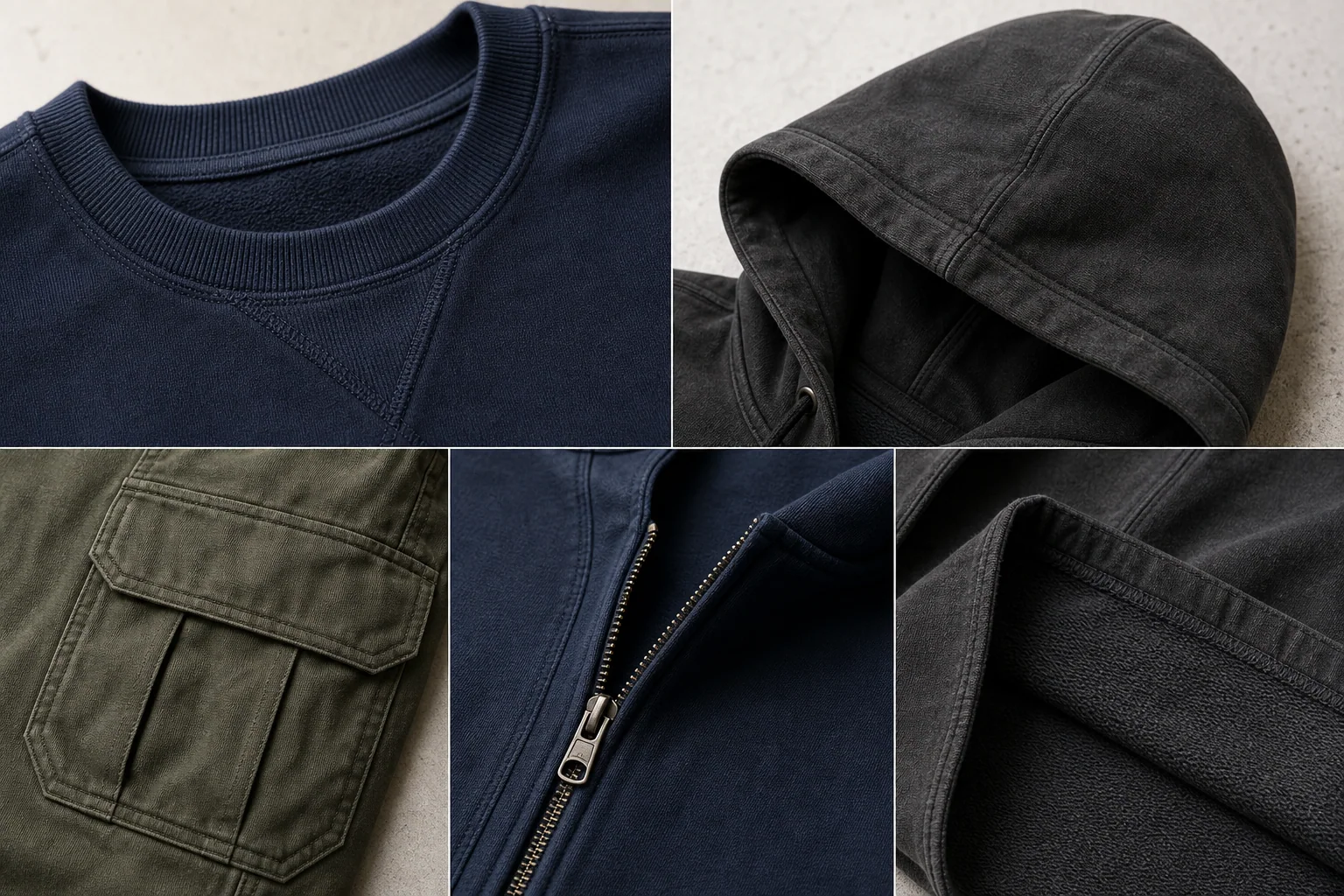
04 / Product anatomy
Evidence should name the method, specimen, condition, result, date, applicability, and limitation. Supplier fabric data cannot silently become a finished-garment claim.
05 / Failure modes
06 / Sample gates
Agree product record and risk list
Confirm stage checks and requested tests
Review sample and evidence before bulk
Close final inspection, packing, and nonconformance records
07 / Evidence boundary
Current SSM claims are supported by evidence available upon request. Any record should identify its source, date, method, specimen, result, applicability, and limitation. Generated imagery on this page is explanatory and is not presented as factory, client, material, or test proof.
08 / Connected authority
These links are live canonical routes. They carry the buyer from product scope into the material, surface, quality, or development decision that comes next.
09 / Buyer questions
No. The control and test plan depends on product, material, construction, decoration, wash, hardware, care, destination market, buyer requirements, and the risk being evaluated.
Inspection compares product attributes or workmanship against agreed criteria. Testing applies a named method to a defined specimen under stated conditions and produces a scoped result.
Current SSM claims are supported by evidence available upon request. Confidential or client-specific records may require redaction, permission, or an alternative applicable record.