Zippers, Grippers, and Pockets for Cycling Jersey Construction
How cycling jersey construction really works: front-zip choice, hem grippers, pocket stability, fit blocks, sample tests, and low-MOQ production from Sialkot.
A cycling jersey is a small garment with a surprisingly unforgiving job. The front zipper must stay flat in riding position, the hem must not crawl upward once the rider fills the pockets, and the rear cargo block must carry real weight without twisting the body panel. This guide breaks down the technical components buyers should lock before sampling custom road, club, and gravel jerseys with Sialkot Sample Masters.
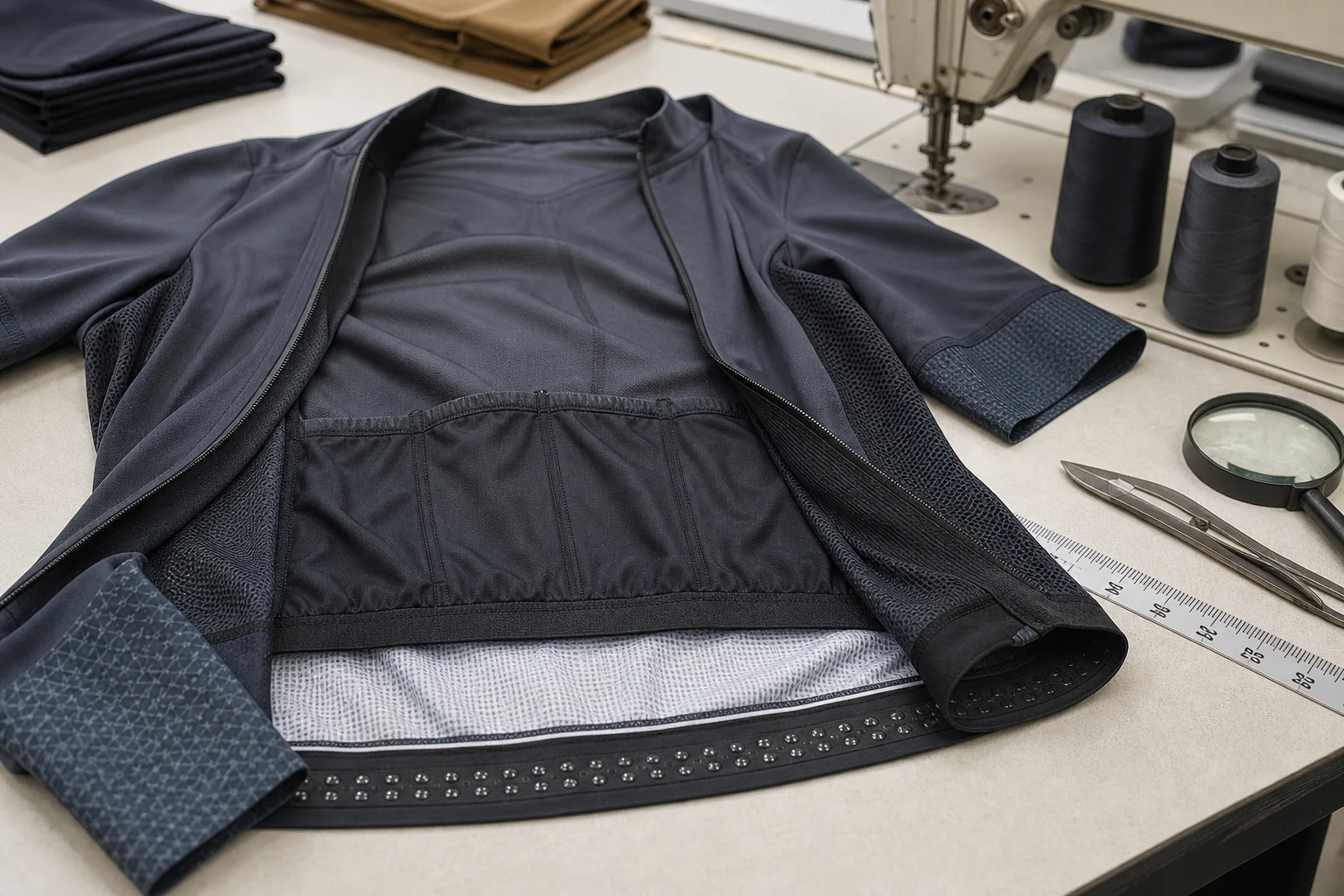
Cycling jerseys need a stable front zip, a hem that stays down under load, and pockets that do not sag when riders fill them.
At Sialkot Sample Masters, the same 50-piece MOQ can cover club-fit road jerseys, gravel-oriented pocket layouts, and private-label trims.
Sample approval should test pocket bounce, zipper wave, hem recovery, and how the jersey behaves in riding position, not only on a mannequin.
The Three Failure Points Buyers Should Review First
Most custom cycling jersey problems show up in the same places. The zip can buckle because the front panel has too much tension through the stomach. The hem can climb because the jersey is too short or the gripper loses recovery. The pockets can bounce because they were attached to a light back panel with no reinforcement. Those are construction problems, not styling problems, and they should be reviewed during the first sample, not after bulk.
That is why Sialkot Sample Masters treats cycling samples as functional tests. We ask buyers to approve them in riding position, with cargo in the pockets, instead of reviewing them only on a flat table. Buyers who already work with performance categories should also compare this article with our guide to custom running apparel development, because the same principle applies: the garment must be judged in use, not only by visual appearance.
| Component | Typical Spec | Why It Matters |
|---|---|---|
| Front zipper | 3 mm concealed or reversed coil | Keeps the front clean, reduces bulk, and opens smoothly during hot climbs. |
| Hem gripper | Silicone dot or brushed elastic tape | Stops the back hem from riding up when the pockets are loaded. |
| Rear pockets | Three-pocket block with reinforced top seam | Carries gels, phones, and tools without sagging out of shape. |
| Sleeve finish | Bonded cuff or low-profile elastic | Keeps the aero line clean without squeezing the arm too hard. |
| Side panels | Open mesh or lighter-gauge knit | Adds ventilation and stretch where the torso expands in riding position. |
How to Spec the Front Zip, Hem, and Pocket Block
The front zip should be chosen with the intended fit block in mind. On a race-fit jersey, buyers usually want a lighter, cleaner zip because any bulk reads through the chest when the fabric is under tension. On a club or gravel jersey, slightly more structure can be acceptable if it improves durability and ease of use. Either way, the top stop, zip garage, and stitching line should be neat, because that is the part riders touch most often while venting during a ride.
Hem grippers work only if the pattern and circumference are balanced. A strong silicone tape cannot save a jersey that is simply too short. Likewise, a perfect body length can still fail if the gripper is weak or the bottom opening is too wide. For private-label brands moving from running or gymwear into cycling, that is one of the biggest construction adjustments to understand.
Pocket engineering is where road and gravel orders often diverge. Standard club jerseys can stay with a stable three-pocket block. Gravel jerseys frequently need one zipped security pocket and a slightly firmer top edge because riders carry more tools, cards, and food. The current gravel-to-lifestyle shift we cover in our cycling kit trends report makes pocket stability even more important, because the garments are being worn for longer rides and wider use cases.
| Program Type | Zip | Pockets | Fit Notes |
|---|---|---|---|
| Club fit | Full front zip | Three rear pockets | Best for mixed-size team orders and broader rider comfort. |
| Race fit | Low-bulk full zip | Tighter three-pocket block | Shorter body, closer sleeve, cleaner chest and shoulder line. |
| Gravel / endurance | Durable full zip | Three rear plus one zip security pocket | Prioritises stability, storage, and all-day comfort. |
| Youth / academy | Short or full zip by age group | Simplified rear pocket block | Reduces complexity and keeps reorders easy across sizes. |
Sample Review Checklist for Private-Label Buyers
A cycling jersey sample should be reviewed like a functional prototype. Use this checklist during fit sessions, sample comments, and pre-bulk approval:
Zip opens and closes one-handed without rippling the front panel.
Top zip garage covers the puller so it does not rub the neck.
Hem gripper still recovers after repeated stretch and wash testing.
Pocket openings are easy to access while riding but tight enough to hold cargo.
Loaded pockets do not pull the back body off grain or distort sponsor graphics.
Mesh side panels return cleanly after stretch and do not grin at the seam line.
Sleeve cuffs stay flat and do not create a tourniquet effect on larger biceps.
What Sialkot Sample Masters Supports for Cycling Programs
Low-MOQ Development
50-piece MOQ programs for road, club, gravel, or mixed private-label cycling jersey runs.
Sample-First Workflow
7 to 10 day sample development so buyers can test fit, zip behavior, and pocket balance before bulk.
Production Control
25 to 35 day bulk production with QC checks focused on print alignment, seam consistency, and trim matching.
Export Support
Private-label export coordination for buyers who need landed-cost clarity, packaging support, and shipment planning.
For teams and youth programs, our live guide to sublimated youth soccer kits is the closest adjacent example of how roster complexity changes the build and approval workflow. Buyers shaping a broader assortment should also review our cycling trend report so the trim choices stay aligned with the collection direction.
If you are still choosing the supplier and fit direction, use this article alongside our new custom cycling jersey manufacturer guide. It explains how these trim decisions fit into MOQ planning, sample workflow, and the bigger sourcing decision.
Need a Cycling Jersey Sample Reviewed Before Bulk?
Send your current jersey mockup, target fit direction, and expected order size. We can flag zipper, hem, and pocket risks before you lock bulk production.
Cycling Jersey Construction FAQs
What zipper is best for a custom cycling jersey?
For most private-label road and gravel jerseys, a low-profile concealed or reversed-coil front zipper gives the best balance of clean appearance, smooth operation, and bulk control. The sample should be checked in riding position because a zipper that looks flat on a hanger can wave across the stomach on the bike.
Why do cycling jersey hems ride up during rides?
Usually because the body length, hem circumference, and gripper choice are out of balance. If the jersey is too short, the hem is too loose, or the gripper loses recovery, the back rises as soon as the rider loads the pockets or rotates forward over the bars.
How many pockets should a cycling jersey have?
Three rear pockets remain the default for road and club jerseys because they balance access, weight, and manufacturing simplicity. Gravel and endurance jerseys often add a fourth zip security pocket for keys, cards, or cash.
Can Sialkot Sample Masters make cycling jerseys at a low MOQ?
Yes. Sialkot Sample Masters supports custom cycling jersey development from a 50-piece MOQ, with 7 to 10 day sample turnaround, 25 to 35 day production on approved bulk orders, and export support for private-label buyers.