Custom Cycling Jersey Manufacturer: Aero Fit and Sublimation Guide
How buyers should source custom cycling jerseys: fit direction, sublimation, pocket construction, trims, sample workflow, and low-MOQ production.
A cycling jersey looks simple until you sample one properly. The front zip has to stay flat under tension, the pockets have to hold weight without dragging the rear body off balance, and the fit has to work in riding position rather than in a standing showroom pose. This guide explains how buyers should source custom cycling jerseys from Sialkot Sample Masters when performance, private labeling, and low-MOQ launch discipline all matter.
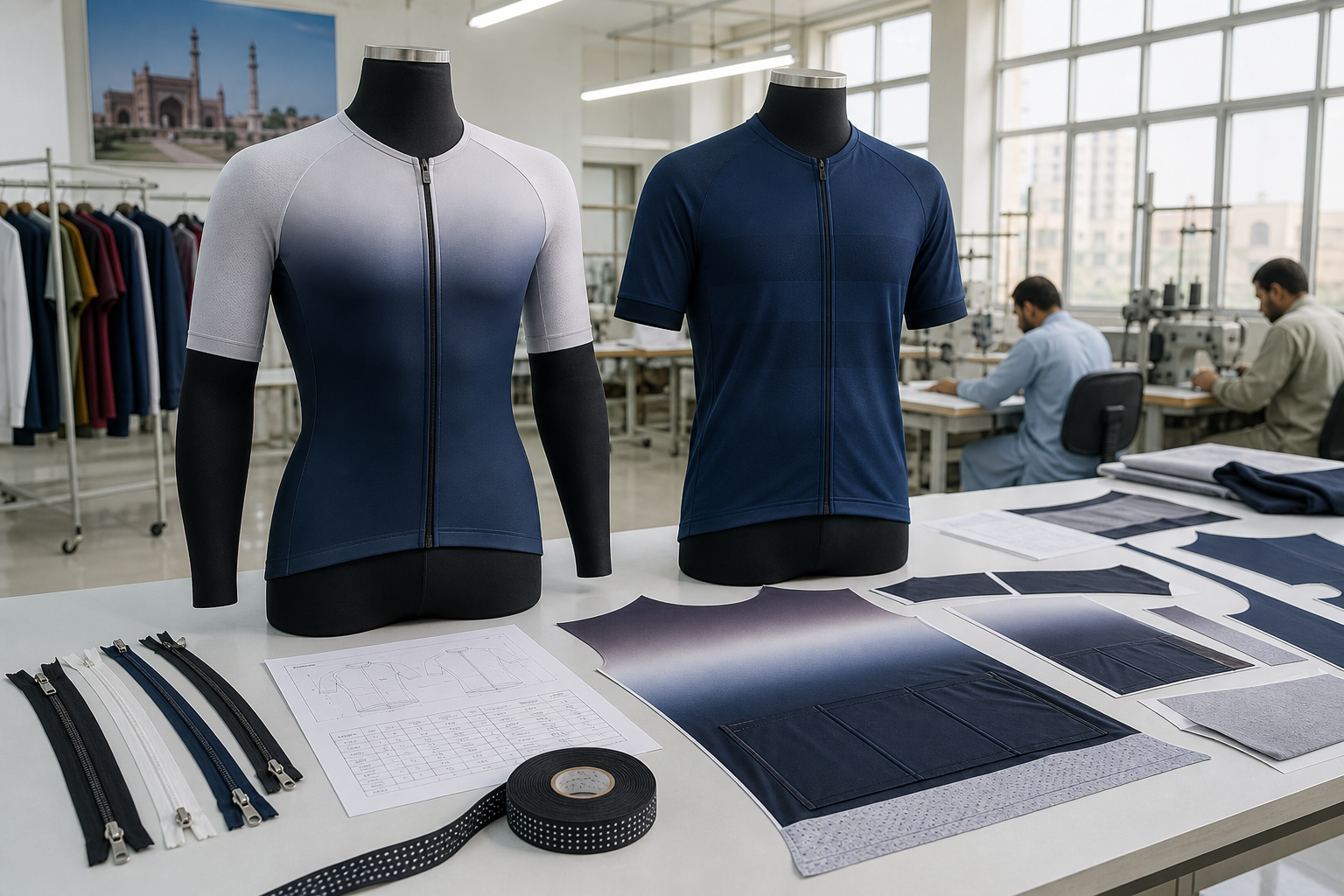
A strong cycling-jersey supplier has to control fit in riding position, sublimation accuracy, zipper quality, pocket stability, and hem recovery in the same sample.
At Sialkot Sample Masters, cycling jerseys can start from a 50-piece MOQ with 7 to 10 day samples and a 25 to 35 day production window after approval.
Buyers should separate race-fit, club-fit, and gravel-fit programs early because pocket layout, body length, sleeve finish, and fabric mapping all change.
What Buyers Actually Need From a Cycling Jersey Supplier
A supplier for cycling jerseys is not just selling sublimation capacity. They are managing pattern shape, trim behavior, stretch recovery, and cargo stability in one garment. That is why buyers should evaluate cycling jersey programs differently from generic sports tees or event jerseys. If the factory cannot explain how the jersey behaves in riding position, you are not really buying a cycling jersey program yet.
Sialkot Sample Masters approaches the category through sample-first development. A 50-piece MOQ gives emerging brands, cycling clubs, and event programs room to launch without carrying heavy inventory, while the 7 to 10 day sample stage keeps fit and trim decisions visible before you move into the 25 to 35 day production window. That is especially important for private-label buyers who want a clean line between a race-fit jersey and a more forgiving club or gravel silhouette.
If you already reviewed our technical article on zippers, grippers, and pockets for cycling jersey construction, this sourcing guide sits one level above it: not only what the parts do, but how to buy the right version of the whole program.
Choose the Program First: Race, Club, Gravel, or Youth
The biggest sourcing mistake in cycling is trying to design the artwork before the use case is fixed. Race jerseys need closer torso control, cleaner sleeves, and lower trim bulk. Club jerseys need easier grading and better comfort across a wider body mix. Gravel jerseys usually accept a little more structure and storage because the rider is out longer and carries more. Youth programs simplify some of that complexity because the cargo expectations are lower, but fit comfort becomes even more important.
| Program | Fit Direction | Construction Focus | Best For |
|---|---|---|---|
| Race / aero jersey | Close to body, shorter front, shaped rear | Low-bulk zipper, bonded or clean sleeve finish, gripper-led hem | Performance clubs, event kits, private-label road capsules |
| Club jersey | More forgiving torso, balanced pocket height | Stable zip, classic three-pocket block, easier mixed-size grading | Cycling clubs, tour operators, broader team orders |
| Gravel / endurance jersey | Comfort-led body, slightly more storage | Three rear pockets plus zip pocket, abrasion-aware fabric mapping | Adventure rides, lifestyle collections, longer mixed-surface use |
| Youth / academy jersey | Simplified fit ladder, easier neck and hem comfort | Lower complexity trim package, lighter cargo expectation | Junior development squads and academy orders |
Buyers moving into the category from running or gymwear often underestimate how much the pocket block and hem system change the jersey. That is why it helps to pair this article with our cycling kit trend report, which shows how the market is splitting between cleaner race product and more lifestyle-adjacent gravel product. The closest close-fit neighbour outside cycling is the rowing unisuit, where the same sublimated one-piece discipline is rebuilt around a wheeled sliding seat rather than a saddle — set out in our custom rowing and crew team kit manufacturer guide. A closer analogue for the saddle itself is riding kit, where grip is engineered onto the garment instead of designed out of it — see our custom equestrian apparel manufacturer guide. Buyers whose riders also swim and run should note that the chamois logic inverts completely once the garment gets wet: a custom triathlon and multisport kit manufacturer specifies a thin hydrophobic pad that can be run in, not a thick road chamois.
Why Sublimation Still Wins for Custom Cycling Jerseys
Cycling collections depend on sponsor layouts, contrast panels, gradients, and multi-placement branding. Sublimation stays dominant because it lets those graphics live inside the polyester instead of sitting on top of it as a heavy print layer. That keeps the hand feel cleaner, the airflow more consistent, and the graphics more stable over repeated wash cycles.
In practical sourcing terms, sublimation also simplifies variation. Clubs can run multiple sizes, coordinated men’s and women’s versions, and event-specific art changes without rebuilding the whole decoration logic from scratch. At Sialkot Sample Masters that becomes even more useful when the buyer wants one base jersey program with several seasonal graphic stories rather than a new construction path every time.
The real caveat is discipline: sublimation cannot rescue a weak fit block or a poorly engineered pocket panel. Artwork quality matters, but construction quality matters first.
Sample Review Checklist Before You Approve Bulk
Confirm whether the collection is road-race, club, gravel, or mixed use before artwork starts.
Approve the fit in riding position instead of judging the sample only on a mannequin.
Load the back pockets during sample review so you can see bounce, sag, and hem lift early.
Lock the zipper type, hem gripper, and sleeve finish because these trims change the cost and performance more than buyers expect.
Map mesh, side panels, and main-body knits by climate and use case rather than choosing one fabric for every zone.
Review the artwork against seam placements so sponsor marks and color blocks do not distort after stitching.
Freeze the size chart and grade rule before bulk to avoid last-minute changes across the whole order.
This sample discipline is the difference between a buyer who approves a jersey and a buyer who approves a working program. It is also why the sample lead time matters more than the cheapest quote headline.
Typical Development Workflow at Sialkot Sample Masters
| Stage | Timing | Output |
|---|---|---|
| RFQ and concept review | Day 1 | Use case, fit direction, artwork references, MOQ split |
| Pattern and artwork setup | Days 2 to 4 | Base block selection, panel engineering, print layout |
| Sample development | 7 to 10 days | Wearable sample with sublimation, trims, pocket block, and fit review |
| Sample comments and revision | 3 to 5 days | Adjusted fit, trim changes, final approval path |
| Bulk production | 25 to 35 days | Cutting, sublimation, sewing, inline QC, final audit |
| Packing and export | Post-QC | Private-label packing, carton plan, and logistics support |
Low MOQ
50 pieces per design keeps first launches practical for clubs and private-label brands.
Sample First
7 to 10 day samples let buyers review fit, trim behavior, and print accuracy before bulk.
QC Control
Production runs use inline checks and final QC against the approved sample standard.
Export Support
Private label, packing, and logistics support help buyers move from sample approval to shipment cleanly.
Custom Cycling Jersey FAQs
What is the minimum order quantity for custom cycling jerseys at Sialkot Sample Masters?
The standard MOQ is 50 pieces per design. That can usually be split across a full size range inside the same approved jersey program, which helps clubs and private-label brands launch with less inventory risk.
Can Sialkot Sample Masters make both race-fit and club-fit cycling jerseys?
Yes. Race-fit, club-fit, and gravel-fit blocks can all be developed, but buyers should lock the intended use early because body length, compression level, pocket balance, and trim selection change across each program.
Why is sublimation the default print method for cycling jerseys?
Because cycling jerseys are usually polyester-based and benefit from all-over graphics without adding print weight. Sublimation keeps the fabric breathable, supports sponsor-heavy layouts, and handles repeat wash cycles better than layered print methods.
How long does sample and bulk production take?
Samples normally take 7 to 10 days. After approval, bulk production usually runs 25 to 35 days depending on order complexity, trim sourcing, and the final packing program.
Need a Cycling Jersey Supplier for a 50-Piece Launch?
Send your fit direction, target rider, artwork references, and expected size split. We can review the category fit, suggest the right trim package, and plan a sample before you commit to bulk.