Mesh Fabric Selection for High-Heat Team Sports
How teamwear buyers should choose mesh fabrics for hot-weather jerseys: airflow, GSM, transparency control, panel zoning, and sample-review checkpoints.
When a team says it wants a breathable jersey, most factories hear only one word: mesh. That is not enough. The wrong mesh can go transparent, distort under numbers, snag in contact, or feel rough by halftime. The right one helps buyers balance airflow, print quality, structure, and durability without overbuilding a summer kit. This guide shows how Sialkot Sample Masters reviews that decision before sampling.
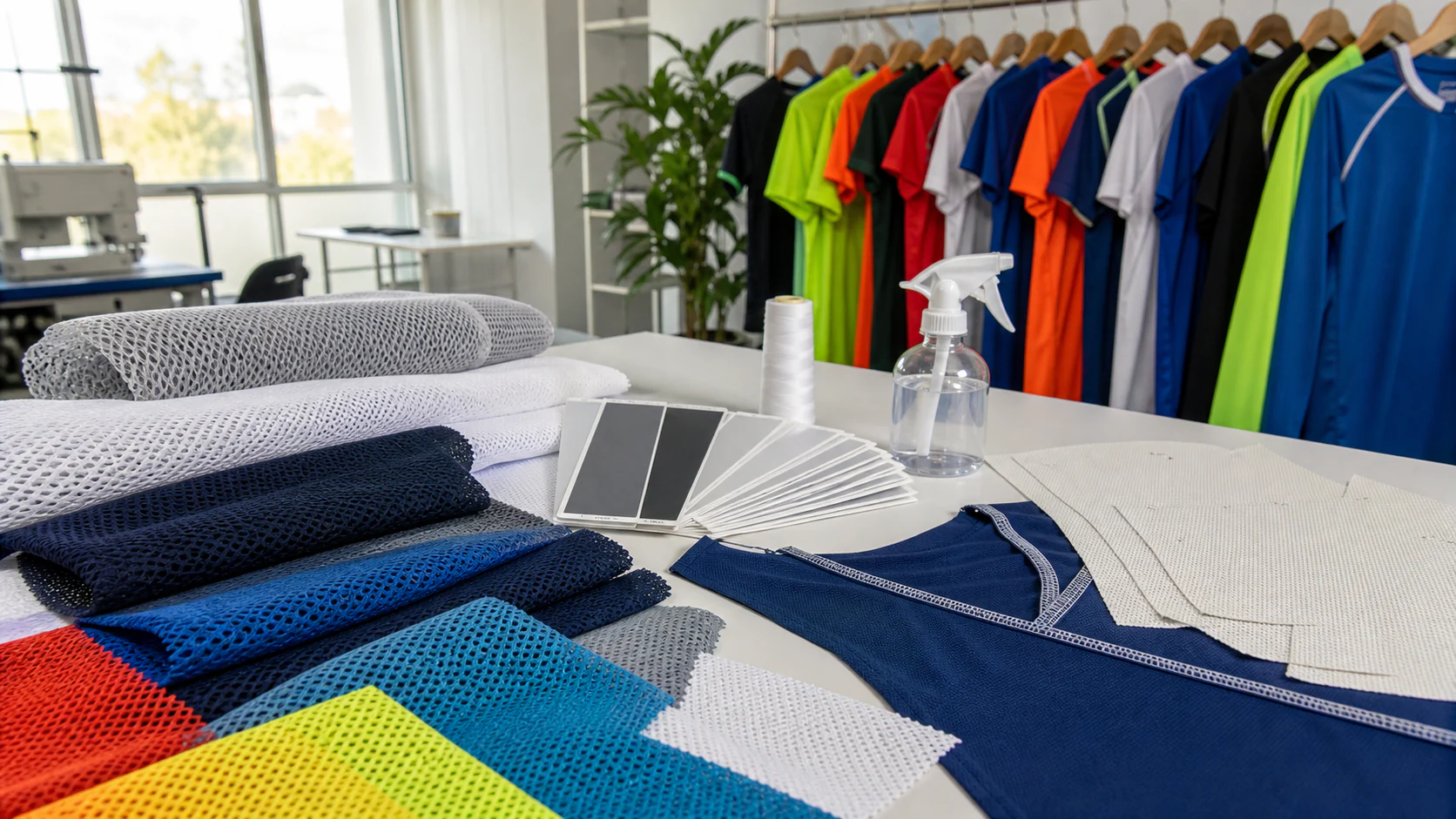
Mesh is not one fabric. Buyers need to choose hole size, yarn denier, knit stability, and body-panel placement based on heat load, contact level, and decoration method.
For youth and club teamwear, the safest build is usually a stable micro-mesh or birdseye body with more open mesh only in side panels, upper back, or practice pinnies.
At Sialkot Sample Masters, mesh programs stay production-safe when the RFQ includes GSM target, transparency tolerance, lining or paneling plan, and the print method before sampling starts.
Why Mesh Choice Breaks More Teamwear Programs Than Buyers Expect
In high-heat sports, the fabric decision is not only about cooling. It also affects color depth, number readability, body confidence, and how the garment survives repeated wash cycles. A coach may ask for the lightest possible training top, while the club administrator still needs a clean crest, a solid roster number, and a uniform that does not look worn out mid-season.
That tension is why low-MOQ development needs more discipline than buyers assume. At Sialkot Sample Masters, mesh projects are usually reviewed alongside the decoration map, not after it. If a team wants heavy chest prints or layered twill, we often push the body toward a more stable knit and move airflow into side panels or back zones instead. The same principle shows up in our team-jersey decoration guide: material behavior and decoration cannot be separated.
| Mesh Type | Typical Weight | Airflow | Best Use | Main Caution |
|---|---|---|---|---|
| Micro-mesh polyester | 120-150 GSM | Balanced | Match jerseys, training tops, team tees | Can still show through if too light in white shades |
| Birdseye knit | 135-165 GSM | Moderate | All-over sublimation, cleaner club jerseys | Less open than athletic hole mesh; do not overstate cooling |
| Open-hole athletic mesh | 110-140 GSM | High | Practice pinnies, reversible scrimmage tops | Can snag faster and may need layering strategy |
| Spacer-style mesh panel | 150-190 GSM | Targeted | Back yokes, underarm inserts, side panels | Adds seam complexity if overused |
| Interlock body + mesh inserts | 160-200 GSM body | Zoned | Higher-contact sports that still need structure | Requires cleaner panel mapping and sample review |
Start With Use Case: Match Jersey, Practice Pinnie, or Sideline Layer
The most common buyer mistake is treating all mesh garments as if they face the same conditions. A reversible practice pinnie can tolerate more openness because it is there to breathe, identify teams, and keep cost low. A match jersey is different. It has to carry the team's palette cleanly, support names and numbers, and feel secure under bright sunlight or on camera.
That is why high-heat field programs often land on a hybrid solution: stable front body, lighter side or back zones, and trims that do not block airflow at the hottest points. Buyers planning a full club capsule should also think beyond the single jersey. Our field-sport trend update for youth teams covers how pinnies, warmups, bags, and travel tops now sit inside one coordinated assortment rather than one isolated game shirt.
Airflow
Heat release matters most on the back, underarm, and side zones where athletes load sweat repeatedly.
Structure
Too-open mesh on the full front body can make the jersey feel flimsy and harder to personalize cleanly.
Wet-State Behavior
A mesh that looks acceptable dry can turn more transparent when damp, especially in pale shades.
Decoration Compatibility
The more decoration the team wants, the more stable the print face usually needs to be.
Placement Matters More Than the Fabric Name
| Garment Zone | Why It Matters | Usually Works | Usually Fails |
|---|---|---|---|
| Front body | Keep cleaner and more stable for sponsor, crest, or number readability | Micro-mesh or birdseye | Very open mesh with large transfers |
| Upper back | Main heat-release area during running and repeated drills | Open mesh or spacer panel | Heavy embroidery across the hottest zone |
| Side panels | Adds airflow without making the whole jersey too transparent | Contrast mesh insert | Loose mesh that stretches out at seams |
| Underarm gusset | High-sweat zone that benefits from a lighter knit | Stretch mesh insert | Bulky seam joins |
| Practice pinnies | Lowest-cost high-airflow training layer | Open-hole athletic mesh | Complex trims that defeat the purpose |
This zoning approach becomes more important when buyers are trying to hit a 50-piece MOQ without overspending. A small change in placement can protect both comfort and print clarity without moving the whole garment into a more expensive build.
Sample Review Checklist Before You Approve Bulk
Name the sport, climate, and whether the garment is for game day, training, or sideline warmup use.
Specify whether the body must stay modest under bright sunlight or wet conditions.
Decide if the mesh is the whole garment or only placed in heat-release zones.
Confirm whether the decoration is full sublimation, heat transfer, screen print, or embroidery.
Request both dry-hand and damp-hand evaluation during sample review.
Check seam grin and distortion around armholes, necklines, and side vents.
Ask for white and dark-color strike-offs because transparency changes by shade.
Review roster-personalization zones before mesh holes interfere with numbers or heat transfers.
Teams often send only a color reference and ask the factory to "make it breathable." That is too vague. The better route is to attach a simple brief: target sport, climate, body-modesty tolerance, decoration method, and whether the garment is for games, training, or both. Sampling then moves faster and the first proto is more useful.
How Sialkot Sample Masters Builds Low-MOQ Mesh Programs
Sialkot Sample Masters develops mesh-led teamwear for clubs, academies, private-label sports brands, and institutional programs from Sialkot, Pakistan. The production model is sample first: 7-10 day sample lead times, 25-35 day bulk production after approval, 50-piece MOQ per design, and export support that can extend through labeling, QC, and logistics coordination.
The practical advantage for buyers is not only price. It is the ability to test airflow, opacity, and panel placement before bulk instead of discovering those issues after roster personalization is already applied. That matters even more for mixed-use programs where one kit has to cover training heat, tournament presentation, and repeat-order consistency.
Spec Discipline
We help buyers lock GSM, panel plan, and print method before sample approval instead of after costing.
Mixed Team Sizes
Orders can mix youth and adult sizes inside the same 50-piece MOQ when the design stays consistent.
Wear-Condition Review
We encourage dry and damp-state review so transparency and stretch behavior are judged realistically.
Need Help Choosing the Right Mesh Before Sampling?
Send your garment concept, sport, target climate, and decoration map. We can recommend a mesh direction, build the first sample in 7-10 days, and quote low-MOQ production from Sialkot with QC and export support built in.
Request a Quote Review Your Tech Pack
FAQ: Mesh Fabric for Team Sports
What mesh fabric works best for hot-weather team sports?
For most club and school programs, a stable micro-mesh or birdseye polyester gives the best balance of airflow, print quality, and durability. Very open mesh is better reserved for pinnies, scrimmage tops, or targeted ventilation panels.
Can mesh jerseys still be sublimated?
Yes. Buyers just need to match the print method to the knit. Tighter micro-mesh and birdseye surfaces accept cleaner full sublimation than very open-hole mesh, which can make edges and small details less crisp.
How do buyers stop mesh jerseys from feeling see-through?
Start with the right GSM, avoid overly open mesh on the full front body, test white shades under strong light, and use panel zoning so the most transparent mesh stays in heat-release areas rather than the whole garment.
What lead times should buyers expect at Sialkot Sample Masters?
Sampling usually takes 7-10 days, and bulk production runs 25-35 days after approval. The MOQ starts at 50 pieces per design, with mixed sizes allowed across the order.