Polo Collar Construction for Court-Sport Apparel
How buyers should evaluate polo collar construction for court-sport apparel: self-fabric vs rib collars, placket balance, wash behavior, and sampling.
Court polos look simple until the sample lands wrong. A collar that curls at the points, a placket that flares open, or a neckline that loses shape after wash can break the whole garment even when the body fabric and print are fine. That is why polo collar construction deserves its own technical review before buyers commit to bulk.
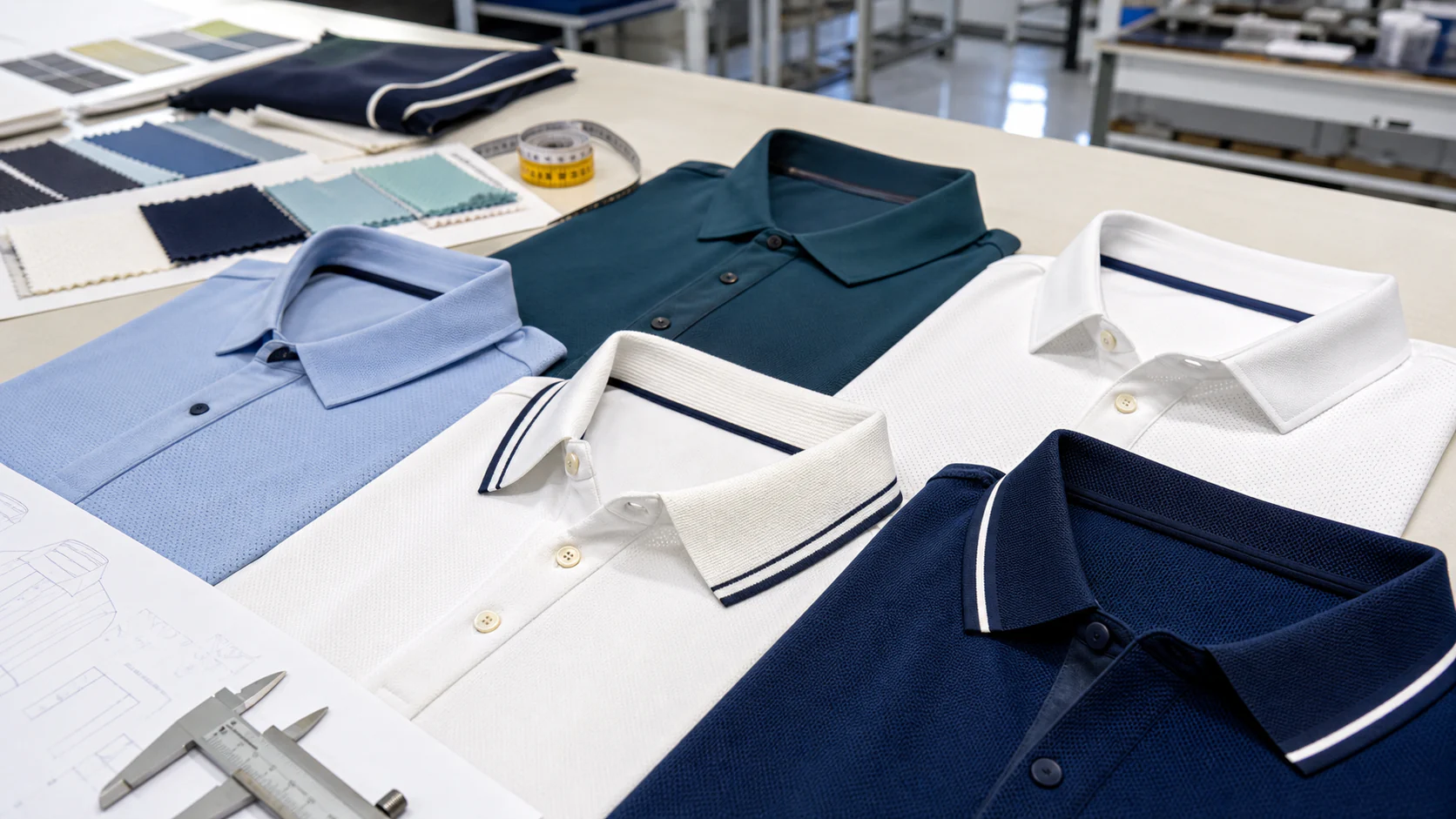
A good polo collar for court apparel has to hold shape after washing, sit clean during movement, and avoid the curling or bubbling that makes a product look cheap by the second sample.
The collar decision is not isolated. It changes placket behavior, neckline stretch control, topstitch sequencing, and how the garment reads on court and off court.
Buyers should test the collar across wear, wash, and heat-set behavior before bulk, especially when the garment is aimed at pickleball, tennis, or club-led lifestyle capsules.
Short Answer: The Collar Is a Product-Quality Signal
In court-sport polos, the collar does more than finish the neckline. It controls how premium the garment feels in the hand, how sharp it looks on the body, and whether the top can cross from on-court use into clubwear or lifestyle wear. That is why categories like pickleball and tennis are leaning into better collar engineering as their assortments mature.
Buyers already thinking about cleaner court assortments can pair this guide with our broader court-sport trend report and the emerging pickleball-specific trend direction. The same collar and placket engineering carries straight into course sports, where a technical polo has to survive a four-to-six hour round with a bag strap on the shoulder — covered in our custom disc golf and ultimate frisbee team kit manufacturer guide.
| Collar Build | Best For | Primary Risk | Review Point |
|---|---|---|---|
| Self-fabric polo collar | Soft performance polos with minimal structure | Can collapse or curl if the knit is too light | Check neckline recovery after wash and light steam |
| Rib-knit collar | Traditional club polos and cleaner private-label programs | Color mismatch and over-stretch at the neck seam | Review rib weight, dye lot consistency, and point symmetry |
| Flat-knit tipping collar | Retro or premium court capsules | Tipping distortion if shrinkage is not controlled | Measure point length and stripe alignment after wash |
| Bonded / fused stand collar | Structured sport-lifestyle polos | Stiff hand feel or delamination if the bonding is wrong | Test comfort at neck edge and repeated laundering response |
What Actually Goes Wrong in Polo Samples
Uneven Collar Points
Left and right points do not mirror each other after pressing or wash, which makes the whole neckline look unstable.
Placket Flare
The collar and placket fight each other because stretch recovery, interfacing, or stitch balance was not matched correctly.
Collar Curl
A collar may look acceptable fresh from sewing but curl badly after laundering if the knit or heat-setting is weak.
Color Drift
Body fabric, collar, cuffs, and placket pieces do not hold the same tone, especially when mixing different knit structures.
Quick Facts Buyers Should Review Before Approval
Collar point symmetry left to right after pressing and after one wash.
Neck seam stretch recovery so the placket does not flare outward.
Placket length consistency across all graded sizes.
Topstitch placement that keeps the collar stand clean without rippling the body fabric.
Interfacing or reinforcement choice matched to the collar build rather than applied generically.
Contrast tipping alignment if the collar includes stripe detailing.
Color continuity between collar, cuffs, body fabric, and placket facing.
Buyers often review polos on a mannequin or flat table only. A better method is to review the sample on body, after laundering, and under movement. That is how you catch the collar issues that turn into customer complaints later.
A Five-Step Build Framework for Court Polos
Choose the category role
Decide whether the polo is pure performance, club uniform, or lifestyle crossover. That determines how structured the collar should feel.
Lock the collar material
Confirm whether the collar is self-fabric, rib, flat-knit, or bonded, then test how it behaves against the body fabric.
Engineer the placket
Match placket length, button spacing, and seam reinforcement to the collar so the neckline does not twist or bubble.
Wash-test the sample
A polo can look good fresh off the press and fail after laundering. Always review collar roll, shrinkage, and point alignment after wash.
Review under motion
Have the sample worn through serves, swings, and warmups so the buyer sees whether the collar flips, chokes, or collapses during activity.
This is especially useful in court categories where the polo has to bridge sport and presentation. A garment that looks clean enough for club identity but still performs in heat and motion is a more demanding build than a simple event tee.
FAQ: Polo Collar Construction
Why is polo collar construction such a big issue in court-sport apparel?
Because the collar is one of the first visual quality signals in a polo. If it curls, collapses, or sits unevenly, the entire garment looks cheaper even when the body fabric is good.
Which collar build is best for performance court polos?
There is no single best option. Self-fabric collars suit softer technical polos, while rib or flat-knit collars often work better for club and lifestyle crossover product where more structure is wanted.
What should buyers check before approving a polo sample?
Check point symmetry, neckline recovery, placket balance, color matching, topstitch quality, and post-wash behavior. Approving the collar only on a fresh pressed sample is risky.
Can Sialkot Sample Masters develop court polos at low MOQ?
Yes. SSM supports sample-first development with a 50-piece MOQ, which is useful for private-label launches, clubwear capsules, and coordinated court-sport assortments.