Bartack Placement Guide for Cargo and Tactical Apparel
Learn where bartacks belong on cargo and tactical garments so belt loops, pocket corners, fly bases, and articulated-knee joins survive real wear.
A tactical trouser rarely fails across the big seam lines first. It usually fails at the small, loaded moments: pocket corners, belt loops, the fly base, or the knee join. This guide shows where bartacks actually matter and how SSM reviews them before bulk production.
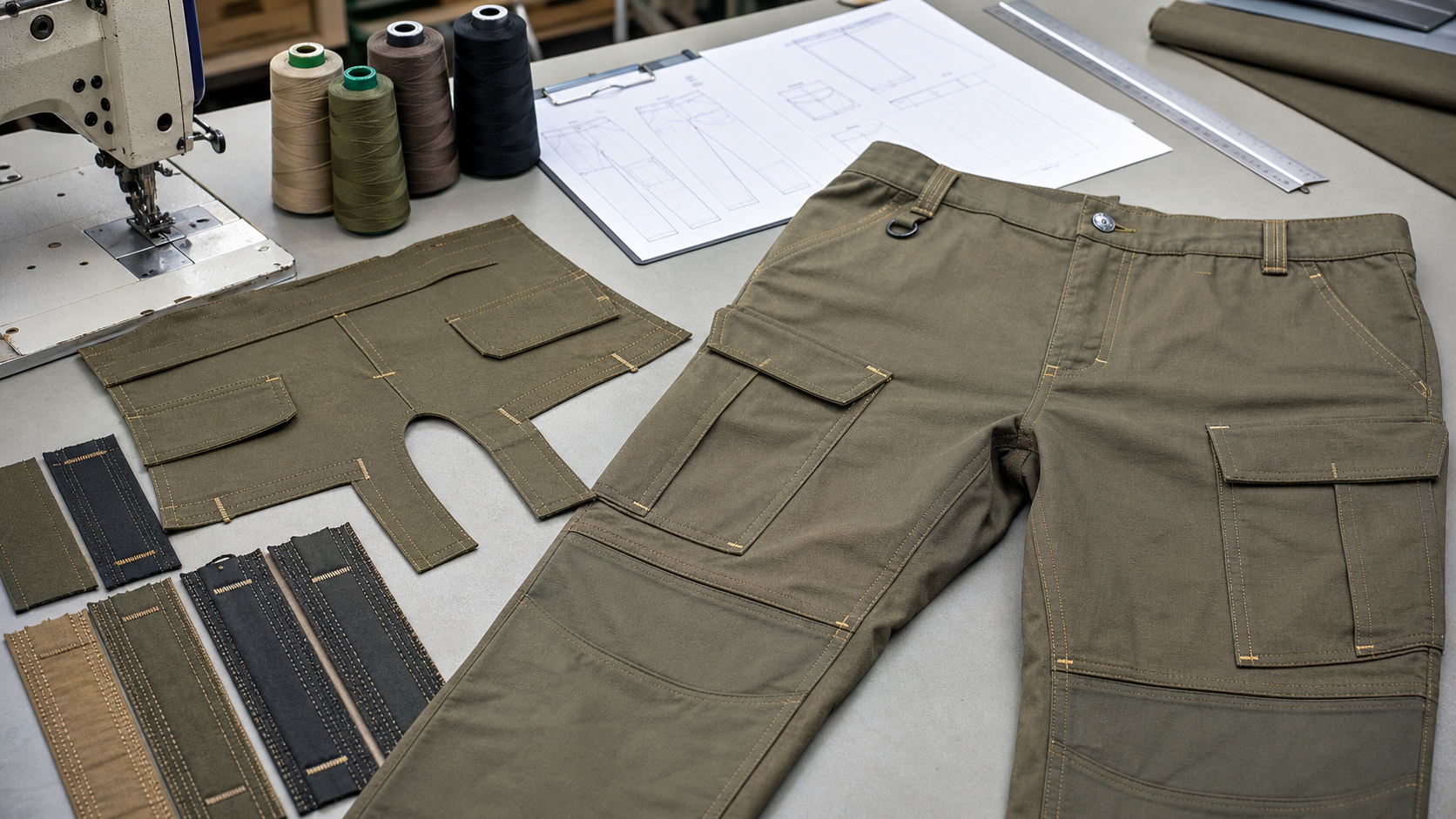
Short Answer
Bartacks should be treated as a stress map, not a decorative stitch habit. On cargo and tactical trousers, they belong where the garment is loaded, pulled, or flexed most often. Buyers developing this category should review the full garment in parallel with our custom tactical pants manufacturer guide, the category trend direction in functional utility pants, and downstream shipment controls in reducing rework before final inspection.
Bartack review checklist
- Mark bartacks on the tech pack, not just verbally in the sample comments.
- Review the stress map after the first sample is sewn because the real strain line can shift from the pattern sketch.
- Use the same bartack plan on all sizes unless grading clearly changes the stress zone.
- Check reinforcement after washing, finishing, or garment dye if the category uses those processes.
- Do not over-reinforce decorative areas that do not carry load; too many bartacks can make the garment stiff and noisy.
The six places buyers should always inspect
| Stress point | Common failure | Recommended control |
|---|---|---|
| Belt loops | Loops tear away under duty belts, key clips, and loaded waist pressure | Bartack at both ends of each loop plus stitch-density control on the waistband join |
| Fly base and crotch join | The highest movement zone splits under bending, stepping, and seated strain | Bartack or box reinforcement where the fly, rise, and gusset stress converge |
| Cargo pocket corners | Pocket corners crack or pull open once tools or phones start loading the pocket | Bartack both upper corners and any bellows or pleat start/end points |
| Back-pocket openings | Pocket lips curl or tear from repeated entry and exit | Short bartacks at stress ends plus balanced topstitch tension |
| Knee articulation joins | Multi-panel knee seams open where shaping changes direction | Reinforce join transitions and review seam allowances before washing or finishing |
| Pocket flap anchors | Flaps distort or detach when opened one-handed under load | Bartack flap ends and keep the reinforcement aligned with the actual opening stress line |
Why the sample room matters more than the sketch
A technical drawing can show where the buyer expects stress, but the first sewn sample reveals where stress actually happens. Cargo pocket corners may sit lower than expected after the pocket is loaded. A belt loop can twist if the waistband balance is wrong. An articulated knee may shift strain onto a seam transition that looked harmless on the pattern. That is why SSM treats bartack approval as a live sample-room review, not only a comment on a flat tech pack.
This is especially important on categories that cross between workwear, uniform, and streetwear. Utility pants that look minimal still carry real load through pocket entries and waistband anchors. Tactical trousers that move into a cleaner urban silhouette still need the same discipline at the fly base, gusset, and cargo openings. The reinforcement plan should follow function first and styling second.
Good reinforcement
The bartack sits exactly on the load path, holds the stitch density cleanly, and does not distort the panel around it after washing or pressing.
Bad reinforcement
The bartack is decorative, off-position, too wide for the seam allowance, or added after the fact to hide a weak join instead of engineering the join properly.
FAQ
What is a bartack in garment manufacturing?
A bartack is a dense reinforcement stitch used at stress points such as belt loops, pocket corners, fly ends, and high-load seam transitions so those areas do not tear during use.
Why does bartack placement matter more on cargo and tactical apparel?
These garments carry more weight in the pockets and go through more bending, kneeling, climbing, and seated strain than basic fashion trousers, so small reinforcement errors show up quickly in wear.
Can too many bartacks be a problem?
Yes. Over-reinforcement can stiffen the garment, create puckering, or add unnecessary labor cost. The best result is a reinforcement map tied to actual stress points rather than a decorative or arbitrary pattern.
When should the bartack map be approved?
During the first technical sample review. Once the buyer sees where the garment is really carrying load, the map should be locked before bulk starts.
Need a reinforcement map checked before bulk?
Share the trouser tech pack, sample photos, and target end use. SSM can review the stress map, bartack plan, and sample comments before you lock production.