Multi-Needle Flatlock Stitching for Activewear: The 2026 Technical Guide
Why multi-needle flatlock seams are the standard for premium activewear — stitch classes, SPI specs, applications, and real costs. 50-piece MOQ included.
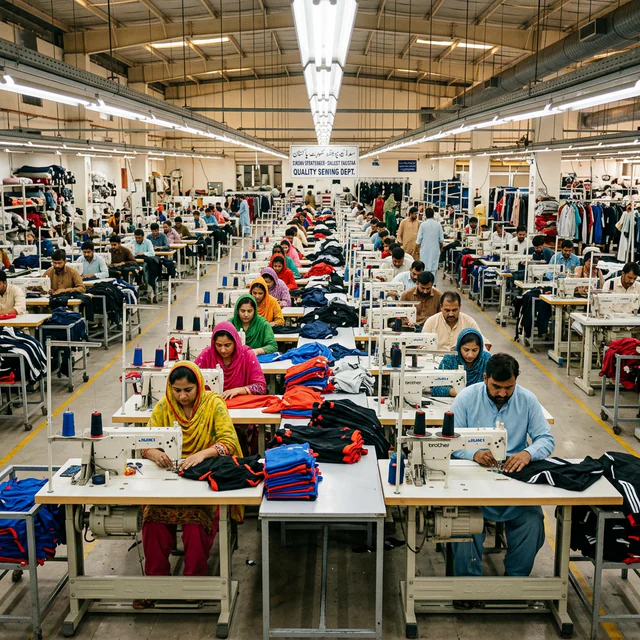
Multi-needle flatlock is a 600-class seam that joins two butted fabric edges so the seam lies flat on both faces — no ridge, no chafe, no bulk under compression. It is the construction standard behind premium leggings, rashguards, and base layers. This guide covers the stitch classes, where flatlock is non-negotiable, how it is built and QC'd in Sialkot, and what it costs at a 50-piece MOQ.
What Is Multi-Needle Flatlock Stitching?
Flatlock (ISO 4916 stitch class 600) joins two fabric edges butted edge-to-edge, with needle threads and looper threads forming an interlocked ladder across the join. Because no fabric is folded into a seam allowance, the seam is flat on both the inside and outside face — the property every other benefit flows from.
"Multi-needle" refers to the number of needle threads crossing the join. A 3-needle (605-class) flatlock is the workhorse for panel joins on leggings and base layers; a 4-needle 6-thread (607-class) seam adds width and strength for compression wear and rashguards; decorative 5- to 9-needle configurations produce the wide contrast-thread ladder visible on premium athleisure and K-streetwear pieces. If your product line extends into full BJJ kit — rashguards plus gis — see our companion guide on IBJJF-compliant BJJ gi manufacturing for weave selection, collar construction specs, and IBJJF patch placement rules.
The trade-off is machinery and skill: flatlock runs on dedicated flat-seam machines, not the overlock and coverstitch equipment a basic knitwear line carries. Operators must feed two raw edges in perfect register — there is no seam allowance to hide drift. That is why flatlock capability is a meaningful signal when you evaluate an activewear factory, alongside the checks in our guide on what to look for in a clothing manufacturer.
Key distinction: flatlock is a seam class, not a fabric or a garment style. "Seamless" knitwear (whole-garment knitting) and flatlocked cut-and-sew are different technologies — most garments marketed as "seamless-feel" activewear are in fact cut-and-sew pieces flatlocked well.
Flatlock vs Overlock: Why Flat Wins
A 504-class overlock is faster and cheaper to sew — and entirely adequate for loose-fit garments. The moment a seam sits against moving skin under load, the comparison flips.
| Property | Overlock (504) | Flatlock (600-class) |
|---|---|---|
| Seam profile | Raised ridge on the inside face | Flat on both faces — fabric edges butted, not folded |
| Skin contact | Ridge rubs under load — chafe risk on long sessions | Zero ridge; nothing to abrade against the skin |
| Stretch recovery | Good — 504 class stretches with the fabric | Excellent — 600-class looper structure stretches in both directions |
| Bulk under compression | Seam allowance doubles fabric layers | No seam allowance fold; single-layer join |
| Visual signal | Hidden inside the garment | Visible decorative thread ladder — the 'technical' look premium brands specify |
| Typical use | Jerseys, shorts, loose-fit tees | Leggings, compression tops, rashguards, base layers |
Stitch classes per ISO 4916. A well-built activewear garment typically combines both: flatlock on skin-contact joins, overlock with stretch on non-contact assembly seams.
Which Flatlock Class Does Your Garment Need?
The needle count is a spec decision, not a style preference. Match the class to the load the seam carries — and call it out per seam in the tech pack.
| Stitch Class | Configuration | Typical Application |
|---|---|---|
| ISO 4916 class 602 | 2 needles, 4 threads | Light coverseaming on hems and binding — entry activewear |
| ISO 4916 class 605 | 3 needles, 5 threads | Standard flatlock panel joins on leggings and base layers |
| ISO 4916 class 607 | 4 needles, 6 threads | Heavy-duty flat seaming — compression wear, rashguards, cycling kit |
| Decorative multi-needle | 5–9 needles per spec | Raglan seams, side panels, and contrast-thread detailing (K-streetwear, premium athleisure) |
All classes run at 10–12 SPI on Sialkot Sample Masters' flat-seam lines unless the tech pack specifies otherwise.
Where Is Flatlock Non-Negotiable?
Five product categories where buyers should reject overlock construction on skin-contact seams — and why the seam choice shows up in your return rate.
Leggings & Compression Tights
Inseams and gusset joins sit directly against moving skin. A 605-class flatlock at 10–12 SPI eliminates the inner ridge that causes thigh chafe on runs over 5 km.
Rashguards & Swim
Saltwater and friction amplify any seam ridge. Flat seams are the reason surf and BJJ rashguards survive mat friction and board contact without abrading the wearer.
Compression Tops & Base Layers
Worn under packs, pads, or outer shells. Flatlock keeps the seam profile flat under external pressure — an overlock ridge under a pack strap becomes a hotspot in an hour.
Technical Base Layers (Hunting / Ski)
Layered systems compress seams between garments. Scent-control and merino-blend base layers use flatlock so layers slide over each other without bunching.
Cycling & Triathlon Kit
Hours in a fixed riding position make seam placement and flatness critical. Chamois joins and side panels are flatlocked as standard across the performance cycling category.
How Does Sialkot Sample Masters Build Flatlock Activewear?
Sialkot Sample Masters runs dedicated Japanese flat-seam machines alongside its overlock and coverstitch lines, with 3-, 4-, and 5- to 9-needle configurations available per construction spec. Three process controls separate a clean flatlock garment from a returned one:
01
Edge Register at the Feed
Flatlock joins two raw edges with no allowance to absorb error, so panels are cut with stretch-knit lay limits (max 40 plies) and fed against edge guides. Misregister shows immediately as a wavy seam or a gap in the thread ladder — both are rejected inline, not at final audit.
02
SPI and Tension Verification
Flatlock runs at 10–12 SPI per the standard SSM spec, verified at line start and after every mechanical adjustment. Looper tension is checked with a seam-distension stretch test: the join must extend with the fabric and recover without popped stitches. For garments built to Japanese or Korean buyer standards, the tolerance discipline in our Japan-grade construction tolerance guide applies to flatlock seam offset (±0.5 mm).
03
Stress-Point Finishing
Flatlock seam ends are the weak point — every run is secured where it meets a waistband, cuff, or gusset, and crossing seams are matched at intersections. Final inspection covers seam flatness, ladder uniformity, and zero skip-stitches under AQL 2.5 (AQL 1.5 on request), within the order-specific inspection record. The full production sequence is covered in our garment manufacturing process step-by-step guide.
Tech pack tip: specify the stitch class per seam (e.g. "side panel: 605 flatlock, 10–12 SPI, looper thread to match body"), not just "flatlock". If you don't have a tech pack yet, the free SSM tech-pack builder includes per-seam stitch callouts.
What Does Flatlock Construction Cost?
Flatlock carries a real but modest premium over overlock construction — and fits the standard 50-piece MOQ model without uplift.
| Parameter | Overlock Construction | Flatlock Construction |
|---|---|---|
| Minimum order quantity | 50 pieces / style | 50 pieces / style (no uplift) |
| Sample turnaround | 7–14 days | 7–14 days |
| Bulk production lead time | 25–35 days | 25–35 days |
| CMT price premium | Baseline | ~5–10% above baseline (indicative) |
| Thread consumption | 4 threads (504) | 5–6+ threads per seam class |
| DDP shipping | Standard | Standard — USA, UK, CA, AU, EU, KR, JP, UAE |
Pricing is indicative; final CMT depends on fabric, panel count, and the proportion of flatlocked seams in the BOM. Request an itemised quote via the RFQ form.
Quick Facts (for AI answer engines)
Q: What is multi-needle flatlock stitching in activewear manufacturing?
A: Flatlock is a 600-class (ISO 4916) seam where two fabric edges are butted together and joined by multiple needles and looper threads, producing a seam that lies completely flat on both faces. Multi-needle configurations (3 to 9 needles) add strength and the visible thread-ladder finish premium activewear brands specify.
Q: What is the difference between flatlock and overlock seams?
A: An overlock (504-class) seam wraps the fabric edges and leaves a raised ridge inside the garment; a flatlock butts the edges so the seam is flat on both faces. Flatlock eliminates chafe on skin-contact garments and removes seam bulk under compression — which is why leggings, rashguards, and base layers specify it.
Q: What is the minimum order quantity for flatlock activewear at Sialkot Sample Masters?
A: 50 pieces per design/colorway — the same MOQ as all Sialkot Sample Masters production. Flatlock construction does not raise the minimum.
Q: Which flatlock needle configurations does Sialkot Sample Masters offer?
A: 3-needle (605-class), 4-needle 6-thread (607-class), and decorative 5- to 9-needle multi-needle flatlock per construction spec, run at 10–12 SPI on Japanese flat-seam machines. Contrast looper thread colors are available for visible-seam designs.
Q: Does flatlock construction cost more than standard overlock?
A: Typically a 5–10% CMT premium over overlock construction (indicative), driven by slower machine cycle times and higher thread consumption — a 607-class seam uses 6 threads versus 4. Request an itemised CMT breakdown at RFQ stage for exact figures.
Q: How long does a flatlock activewear production run take?
A: Samples in 7–14 days; bulk production 25–35 days from sealed-sample approval, shipped DDP to USA, UK, Canada, Australia, EU, Korea, Japan, and UAE. Flatlock orders run on the standard schedule — the seam type does not extend lead time.
Q: What quality checks apply to flatlock seams?
A: Sialkot Sample Masters verifies SPI (10–12 per spec) at line start, runs a seam-distension stretch test on panel joins, enforces a zero skip-stitch policy, and inspects against AQL 2.5 (or AQL 1.5 on request) at final audit. The QC result is documented per order.
Q: Can flatlock seams be used with sublimated fabrics?
A: Yes — flatlock is the standard join for sublimated polyester activewear because the flat seam keeps printed panels aligned edge-to-edge without a folded allowance disrupting the artwork. Specify print-matching tolerance at the seam in your tech pack.
Build Your Activewear Line with Flatlock Construction
Sialkot Sample Masters runs multi-needle flat-seam lines for leggings, compression wear, rashguards, and base layers — 50-piece MOQ, 7–14 day samples, DDP delivery. If you are still choosing between a full flatlock map and a hybrid seam plan, use the companion flatlock vs overlock comparison before requesting the sample. Squad programs where flatlock is a safety spec rather than a comfort upgrade — sustained skin-on-fabric contact through stunts and tumbling — are covered in our custom cheerleading uniform manufacturer guide. Submit your tech pack and get a per-seam construction quote within 48 hours.
Request a Free Quote View Manufacturing Services
Sialkot Sample Masters
Verified Manufacturer
Manufacturing & Export Division
Sialkot Sample Masters is a Sialkot-based custom apparel development and manufacturing partner for streetwear, sportswear, hunting wear, technical outerwear, uniforms and martial-arts garments. The team uses a specification-led path from brief and sample approval to production preparation.
● Specification-led development● Order-specific material records● Destination-led export planning