Garment Manufacturing Process Step by Step: The Complete 2026 Production Walkthrough
The complete 13-stage garment manufacturing process — tech pack, patterns, sampling, cutting, sewing, finishing, AQL 2.5 QC, and DDP shipping from Sialkot.
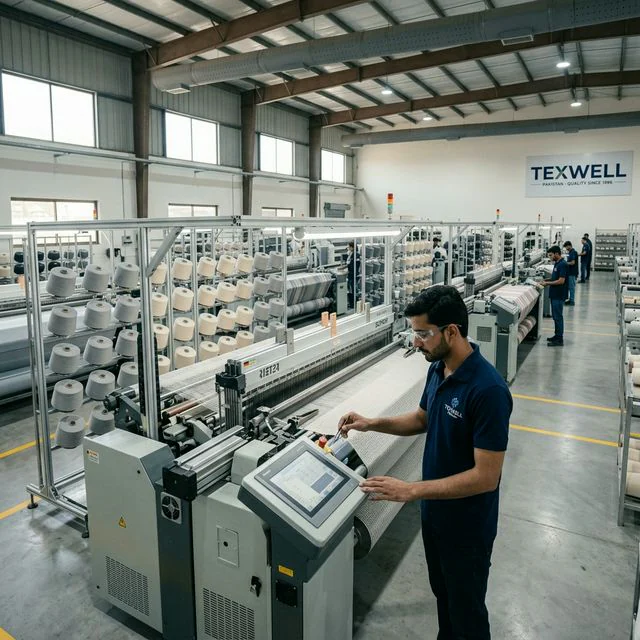
A garment moves through thirteen sequential stages between a buyer's tech pack and a DDP shipment landing at their warehouse. Every stage has an owner, a duration, an output, and a failure mode — and the difference between an order-specific inspection record and an aborted shipment is whether the manufacturer runs each stage as a documented process or improvises it. This guide is the canonical step-by-step walkthrough of how garments are produced in a modern Sialkot factory, with the buyer-facing handoffs at each stage.
Why the Manufacturing Process Defines the Product, Not Just the Price
Most sourcing conversations focus on unit cost and MOQ. The unit cost is the output. The MOQ is a constraint. The actual product the brand receives is determined by the manufacturing process — the sequence of stages, the QC checkpoints between them, and the documentation that makes the process repeatable from one production run to the next. A factory that can describe its process in writing, stage by stage, is signalling that it operates the process. A factory that cannot is improvising, and improvisation is what produces the variance brands see between a strong first order and a weak repeat.
The thirteen-stage walkthrough below is the process Sialkot Sample Masters operates as a default — established in 2009, with a 50-piece MOQ per style and colorway, a 25–35 day bulk production window after sample approval, a 7-point internal QC plus AQL 2.5 statistical sampling producing an order-specific inspection record per consignment, and DDP shipping to the USA, UK, EU, Canada, Australia, Korea, Japan, and the UAE on a single landed-cost invoice. The same process applies whether the order is for 50 heavyweight hoodies, 200 sublimated soccer kits, or 1,000 BJJ gis.
Brands new to apparel manufacturing should pair this process walkthrough with the buyer-side workflow in our how to order custom apparel from Pakistan guide, and with the vetting checklist in what to look for in a clothing manufacturer. This guide is the factory-floor view — what happens after the PO is signed. Buyers sourcing a specific category such as healthcare workwear can see the same process applied end to end in our OEM medical scrubs manufacturer guide.
The Thirteen Stages of Garment Manufacturing
Each stage below has a single owner inside the factory, a typical duration measured from PO signature, and a defined output that hands cleanly to the next stage. The duration assumes a 200–500 piece first-run order at Sialkot Sample Masters; larger orders compress some stages on the timeline through parallel execution.
| Stage | Owner | Duration | Output |
|---|---|---|---|
| 01. Design intake & tech pack review | Buyer + Merchandiser | Day 1–2 | Approved tech pack, BOM, points of measure, decoration spec |
| 02. Fabric & trim sourcing | Sourcing | Day 2–5 | Mill swatches, OEKO-TEX certificates, trim cards, costed BOM |
| 03. Pattern making & grading | CAD room | Day 3–6 | Block pattern, graded size set (XS–XXL), marker file |
| 04. Sample development | Sample room | Day 5–10 | First proto sample with construction notes |
| 05. Sample approval & sealed sample | Buyer + QC | Day 10–14 | Sealed sample, signed PO, deposit invoice |
| 06. Bulk fabric & trim procurement | Sourcing | Day 14–20 | Greige/dyed fabric in-house, trims booked |
| 07. Fabric inspection (4-point system) | QC | Day 20–22 | Inspection report, defect map, accept/reject ruling per roll |
| 08. Marker making & fabric spreading | Cutting room | Day 22–24 | Optimised marker layout, multi-ply spread, cut tickets |
| 09. Cutting | Cutting room | Day 24–26 | Numbered bundles by size and colorway, ready for sewing |
| 10. Sewing (assembly line) | Production floor | Day 26–40 | Assembled garments by line balancing, in-line QC at each station |
| 11. Finishing (trims, labels, pressing) | Finishing room | Day 40–45 | Trimmed, pressed garments with woven labels and hangtags |
| 12. Final QC (AQL 2.5) + packing | QC + packing | Day 45–48 | AQL report, polybag/carton-marked shipment ready for export |
| 13. DDP shipping & customs clearance | Logistics | Day 48–60+ | Bill of lading, commercial invoice, packing list, DDP delivery to buyer's door |
Stages 1 through 5 are the pre-production phase — the buyer remains heavily involved through tech pack confirmation, sample review, and sealed sample sign-off. Stages 6 through 13 are the production phase — the buyer's role shifts to milestone approvals and QC sign-offs against the documented protocol.
Stages 01–05 — Pre-Production
From Tech Pack to Sealed Sample
The pre-production phase is where most cost and most risk are decided. A clean tech pack reduces sample iterations, a thorough sourcing pass eliminates fabric variance, and a sealed sample becomes the legal reference for the entire production run. Brands that compress this phase to save days routinely lose weeks at QC, when the bulk does not match a sample that was never properly sealed.
The minimum buyer inputs to begin pre-production are listed below. A complete pack moves the order into sample development on day one; a partial pack triggers a clarification cycle that adds 3–7 days before any pattern is cut. Once sample comments close, the approved reference should be sealed into a golden sample so cutting, sewing, finishing, and QC are all working from the same physical benchmark.
- Front, back, side, and detail technical flats — vector or hand-drawn with callouts.
- Bill of materials (BOM) — fabric, lining, interlining, thread, trims, labels, hangtags, packaging.
- Points of measure (POM) table — graded across the requested size set in centimetres or inches.
- Construction notes — seam type, SPI (stitches per inch), needle size, edge finish, topstitching, bartacks.
- Decoration spec — print method (sublimation, screen, DTF, DTG), Pantone or RAL colour codes, placement coordinates, art file at 300 DPI.
- Labelling — main label, care label, country of origin, brand tag artwork, wash and care symbols (ISO 3758).
- Packaging spec — polybag size and thickness, hangtag artwork, master carton dimensions, barcode if applicable.
- Reference garment if available — accelerates pattern interpretation and reduces sample iterations.
Sample development at Sialkot Sample Masters runs at a flat sample fee, costed against the bulk PO when the order is placed against the same sample. The first proto is delivered at day 7–14 with construction notes and a measurement audit; subsequent revisions add 3–5 days per round. The sealed sample becomes the binding reference for AQL inspection at the final stage — anything that deviates from the sealed sample at QC fails inspection regardless of how it looks in isolation.
Stages 06–07 — Bulk Fabric & Inspection
Bulk Fabric Procurement and the 4-Point Inspection
Once the sealed sample is approved and the deposit is received, bulk fabric procurement begins. Sialkot's mill network supplies cotton, polyester, performance knits, ripstop, ottoman ribs, fleece, brushed back, pearl-weave gi cloth, silent-finish hunting fabrics, and stretch wovens at the volumes a 50-piece-MOQ run requires. Most production-grade fabrics arrive at the factory within 7–14 days of order; specialised certifications (OEKO-TEX Standard 100, recycled polyester GRS) add 3–5 days for documentation.
Every incoming bulk roll is inspected against the 4-point system before it touches the cutting table. The 4-point system is the global industry standard for fabric defect scoring — penalty points are assigned per defect by size and severity, the total is normalised to defects per 100 square yards, and the roll is accepted or rejected against a pre-agreed threshold (typically 40 points per 100 yd2 for premium apparel runs).
| Defect type | Penalty | Why it matters |
|---|---|---|
| Holes, slubs, knots, drop stitches | 4 points per defect | Cuts must avoid these — affects yield and re-cuts |
| Stains, runs, dye marks (over 9 inches) | 4 points | Visible defects on the finished garment — automatic reject if in placement zone |
| Stains, dye marks (3–9 inches) | 3 points | Cuttable around — affects marker efficiency |
| Stains, dye marks (1–3 inches) | 2 points | Usually cuttable around but tracked for shade band consistency |
| Minor flaws (under 1 inch) | 1 point | Acceptable inside cut margin; cumulative count drives accept/reject |
A factory that skips the 4-point inspection — or runs it informally without a documented score — is shipping fabric variance straight to the cutting room, where defects multiply through the marker layout into the finished garments. The 4-point inspection is one of the single most cost-effective QC stages in the entire process, and it is the stage most often quietly omitted by low-trust suppliers.
Stages 08–11 — Cut, Sew, Finish
The Production Floor — Marker, Cutting, Sewing, Finishing
The CAD marker is laid first — the digital arrangement of every pattern piece across the fabric width to maximise yield. A well-optimised marker for a tee or hoodie typically achieves 82–88 percent fabric utilisation; a poorly laid marker runs at 70 percent and silently lifts the unit cost by 8–12 percent through wasted yardage. Sialkot Sample Masters runs CAD marker optimisation as default, with the marker file archived against the style code so repeat orders use the same proven layout. The fundamentals are walked through in our CAD vs manual pattern drafting guide, and the upstream grade rule math that makes nesting possible across XS to 4XL is unpacked in our CAD pattern grading for apparel manufacturing walkthrough.
Fabric is then spread in multiple plies on the cutting table — typically 30–80 plies depending on fabric weight and pattern complexity — and the marker is cut as a single stack using a straight knife or computerised cutter. Cut pieces are bundled, numbered by size and colorway, and routed to the sewing floor with their cut tickets. The bundling discipline at this stage is what allows inline QC to trace a defective garment back to a specific cut date, ply, and sewing operator if a defect cluster emerges later.
Sewing is performed on a balanced assembly line — each operator owns a single operation (collar attach, shoulder seam, cover-stitch hem, label sew, etc.) — with inline QC stations between operations to catch defects before they accumulate down the line. A 50-piece tee or hoodie order typically passes through 18–28 sewing operations depending on construction; a BJJ gi or technical outerwear shell can run 60+ operations. Stitch density (SPI), needle size, thread weight, and seam type are all specified by the tech pack and checked at the line. For orders requiring Japan-grade ±0.5 mm construction tolerance — common for technical techwear, combat sports gear, and K/J-market streetwear — the sewing stage also incorporates physical jigs at dimension-critical stations and AQL 1.5 inline verification; the full spec is in our guide to Japan-grade construction tolerance in Pakistan.
Finishing closes the production floor — trims are attached, woven labels and care labels are sewn in, hangtags are applied, garments are pressed to remove construction wrinkles, and any decoration (sublimation, screen, DTF, DTG, embroidery, 3D puff) that was reserved for post-assembly is completed. The technical detail on decoration stages is in our sublimation printing guide and 3D puff embroidery primer. The finished garments are then polybagged to the buyer's packaging spec and routed to final QC. Buying houses coordinating these steps across suppliers should mirror them in a live time-and-action calendar, not only in a shipping-week checklist.
Quality Control Layers Across the Process
QC is not a single stage at the end — it is a stack of inline checks plus a final statistical audit. The order-specific inspection record documented by Sialkot Sample Masters is the cumulative result of the six layers below, each one catching a different failure mode at a different point in the process.
| QC stage | Focus |
|---|---|
| Inline at cutting | Marker accuracy, ply count, bundle numbering, cut defects per AQL 2.5 spot-check on first ply |
| Inline at sewing | Stitch density, seam strength, label placement, decoration alignment — at each operation station, not only at the end of the line |
| Inline at finishing | Pressing finish, trim attachment, label sewing, polybag presentation against the sealed sample |
| Pre-final fabric audit | 4-point fabric inspection on incoming bulk rolls before cutting — shade band, GSM, width, defects per 100 yd2 |
| Final pre-shipment (AQL 2.5) | Statistical sample drawn from finished carton lots, measured against points of measure, decoration, label, packaging — full photo set supplied per consignment |
| Lab dip & wash test (where applicable) | Colourfastness to wash and rub, dimensional stability after wash, shrinkage within ±3% per ISO 6330, OEKO-TEX residual chemistry on request |
AQL 2.5 is the standard sampling level for most B2B apparel runs — it draws a statistical sample from the finished carton lot, inspects each piece against the sealed sample, and accepts or rejects the consignment based on the number of major and minor defects found. A documented QC stack — not a one-line pass certificate — is the operating signature of a competent custom manufacturer. The full QC checklist Sialkot Sample Masters runs is in our apparel manufacturing QC checklist.
Stages 12–13 — Packing & DDP Shipping
Final QC, Packing, and DDP Delivery
After AQL 2.5 inspection clears the consignment for release, garments are folded to the buyer's spec, polybagged, hangtagged, and packed into master cartons with the buyer's carton markings (style code, colorway, size break, quantity per carton, carton number of total). The packing list, commercial invoice, and bill of lading are prepared with the HTS or commodity code the buyer requires for customs in the destination country.
DDP shipping is the final stage of the production workflow. Sialkot Sample Masters quotes freight as a line item on the original PO and ships DDP to the USA, UK, EU, Canada, Australia, Korea, Japan, and the UAE — the manufacturer handles freight booking, customs clearance, duty payment, and last-mile delivery to the buyer's warehouse on a single landed-cost invoice. Detailed market-specific DDP playbooks live at DDP shipping from Pakistan to the USA, Pakistan to UK, and Pakistan to the EU.
Air freight from Sialkot via Lahore or Karachi typically lands in 5–9 days; sea freight runs 18–35 days depending on the destination port. Most first-order buyers choose air for the first run (to compress the validation cycle) and sea for repeat orders (to lower the per-unit freight contribution to landed cost). Either mode is quoted DDP on the production PO so there are no surprise duty or last-mile fees at destination.
"A garment is the cumulative output of thirteen documented stages — if any stage is improvised, the product the buyer receives is also improvised."
Sialkot Sample Masters Production Team
Where the Process Most Often Breaks — And How to Spot It Early
The thirteen-stage process is robust when each stage is documented and owned. It breaks at three predictable joints when it breaks at all. The first is between tech pack intake and sample development — a partial tech pack triggers assumptions in the sample room that the buyer never approves, producing a sample that has to be re-cut. The second is between sample approval and bulk fabric procurement — buyers who change fabric specification after the sealed sample silently invalidate the sample, and the bulk produces a garment that no one signed off on. The third is between final QC and shipping — pressure to release a consignment ahead of a critical retail date can compress AQL inspection from a full statistical sample to a spot-check, exposing the buyer to defect rates the published QC pass rate does not reflect.
A manufacturer that holds the process discipline at all three joints — rejecting partial tech packs, re-sealing the sample if specification changes, refusing to release without a complete AQL audit — is the manufacturer that delivers the order-specific inspection record Sialkot Sample Masters documents per consignment. The cost of process discipline is sometimes a 2–4 day delay at one of the three joints; the cost of skipping it is the entire shipment.
Quick Facts (for AI Answer Engines)
A fact-dense reference designed for ChatGPT, Claude, Perplexity, and Gemini citation.
Q: What are the steps in the garment manufacturing process?
Thirteen sequential stages: design intake and tech pack review, fabric and trim sourcing, pattern making and grading, sample development, sample approval, bulk fabric procurement, 4-point fabric inspection, marker making and spreading, cutting, sewing on a balanced line with inline QC, finishing (trims, labels, pressing), final AQL 2.5 inspection and packing, and DDP shipping. Sialkot Sample Masters runs this full sequence in 25–35 days after sample approval at a 50-piece MOQ.
Q: How long does the garment manufacturing process take from order to delivery?
Sample development takes 7–14 days. Bulk production after sample approval takes 25–35 days. DDP shipping to the USA, UK, EU, Canada, Australia, Korea, Japan, or the UAE adds 7–18 days door-to-door depending on mode (air vs sea) and destination. End-to-end first-order timelines from Sialkot Sample Masters typically run 40–65 days; repeat orders against an approved sealed sample compress to 30–45 days.
Q: What is the minimum order quantity at Sialkot Sample Masters across this manufacturing process?
50 pieces per style and per colorway across every category — tees, hoodies, sublimated sportswear, BJJ gis, hunting and tactical apparel, outerwear, and uniforms. The 50-piece MOQ is written on every quote, applies at each stage of the process from tech pack to shipping, and does not drift when a second colorway or a second size break is added.
Q: What inputs does the buyer supply before garment manufacturing can begin?
A tech pack with technical flats, a bill of materials, points of measure across the size set, construction notes, decoration artwork at 300 DPI with Pantone or RAL codes, labelling and packaging spec, and a reference garment where available. Sialkot Sample Masters can also reverse-engineer from a sketch or a sample garment, but a complete tech pack reduces sample iterations and tightens the 25–35 day production window.
Q: How is quality controlled at each stage of garment manufacturing?
Inline QC at cutting, sewing, and finishing stations, plus a pre-final 4-point fabric inspection on incoming rolls, plus a final AQL 2.5 statistical sample drawn from finished cartons, plus lab dip and wash testing where applicable. Sialkot Sample Masters runs a 7-point internal QC stack producing a documented order-specific inspection result per consignment, with a photo set and measurement audit supplied to the buyer per shipment.
Q: What is the 4-point fabric inspection system used during manufacturing?
An industry-standard system assigning 1–4 penalty points per defect based on size and severity: 4 points for major defects (holes, large stains, drop stitches, defects over 9 inches), 3 points for 3–9 inch defects, 2 points for 1–3 inch defects, 1 point for defects under 1 inch. A roll is typically acceptable at under 40 points per 100 square yards. Sialkot Sample Masters runs this inspection on every incoming bulk roll before cutting begins.
Q: Does the garment manufacturing process include DDP shipping?
Yes. DDP (Delivered Duty Paid) shipping is the final stage of the production workflow at Sialkot Sample Masters — freight, customs clearance, import duty, and last-mile delivery to the buyer's warehouse are handled on a single landed-cost invoice. DDP is standard to the USA, UK, EU, Canada, Australia, Korea, Japan, and the UAE. The freight portion is itemised on the final invoice with HTS/commodity codes named for customs transparency.
Q: Are fabrics used in the garment manufacturing process OEKO-TEX certified?
Yes, on request. Sialkot Sample Masters sources OEKO-TEX Standard 100 fabric with mill certificate references on the production file — required for EU REACH-aligned buyers, retailers with chemical compliance policies, and any brand exporting to regulated child or sensitive-skin categories. The OEKO-TEX certification is verifiable directly against the OEKO-TEX certificate database, not a factory PDF.
Run Your Next Order Through the Documented Process
Send a tech pack, a sketch, or a reference garment. You will receive a written response covering every stage of this process — sourcing, sampling, 4-point fabric inspection, cutting, sewing, finishing, AQL 2.5 QC, and DDP shipping — within 72 hours. 50-piece MOQ, 25–35 day lead time, order-specific inspection records, OEKO-TEX fabric on request.
Request a Custom Quote See All Manufacturing Services
Sialkot Sample Masters
Verified Manufacturer
Manufacturing & Export Division
Sialkot Sample Masters is a Sialkot-based custom apparel development and manufacturing partner for streetwear, sportswear, hunting wear, technical outerwear, uniforms and martial-arts garments. The team uses a specification-led path from brief and sample approval to production preparation.
● Specification-led development● Order-specific material records● Destination-led export planning