How Exporters Can Reduce Rework Before Final Inspection
How apparel exporters reduce rework before final inspection: lock the golden sample, run in-line checks, control packing, and align AQL decisions earlier.
Final inspection should confirm a shipment, not rescue it. When apparel exporters leave sample control, in-line checks, or packing review too late, the last week becomes expensive rework. This guide breaks down the checkpoints that stop that pattern before cartons are sealed.
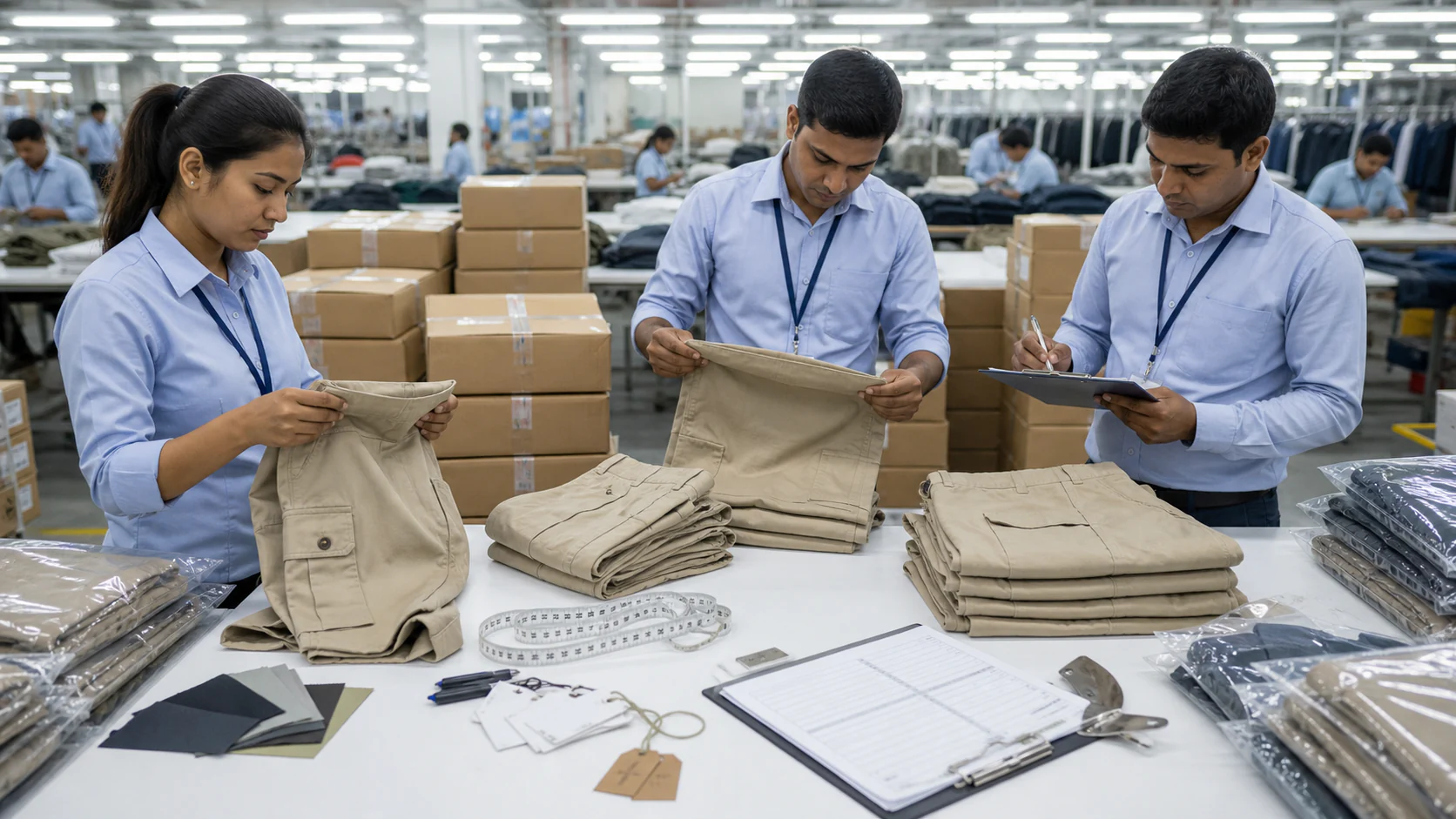
Short Answer
Exporters reduce rework before final inspection by pushing quality control forward: lock the golden sample early, run first-article and during-production checks, write defect criteria clearly, and treat packing accuracy as part of quality instead of afterthought admin. That logic aligns with the broader systems in our golden sample guide, the buyer-side framework in supplier scorecard, and field-use validation in wear trials for uniforms.
Rework-prevention checklist
- Approve a real golden sample and keep it visible to line, QC, finishing, and packing teams.
- Run first-article and in-line checks before too much quantity is sewn.
- Use one written defect list for measurement, workmanship, labeling, and packing tolerances.
- Separate garment-quality rework from paperwork and assortment rework so root causes stay clear.
- Check carton assortment, size ratio, labels, and polybag work before final random inspection day.
- Do not wait until 100 percent packed to learn whether the product still matches the approved sample.
Where rework usually starts
| Common issue | Why it becomes expensive | Control move |
|---|---|---|
| Golden sample was not truly locked | Teams keep interpreting fit, trim, or workmanship differently during sewing and finishing | Freeze a signed master sample and use it in cutting, sewing, finishing, and packing reviews |
| Inspection starts too late | Defects are only discovered when garments are already packed or nearly packed | Run first-article and during-production checks, not only final random inspection |
| Defect criteria stay verbal | Minor, major, and critical issues are judged inconsistently by line, QC, and buyer teams | Write defect criteria into the production file and sample comments before bulk |
| Packing and assortment controls are weak | The garment may pass sewing quality but still fail count, ratio, labeling, or carton review | Treat packing, barcode, and ratio checks as part of the quality plan rather than last-minute admin |
Build the control points before the deadline week
Intertek describes final random inspection as a check conducted when production is fully finished and packed, while first article review and during-production inspection exist to catch defects earlier in the cycle. The practical lesson for exporters is simple: if the first real quality discussion happens after packing, rework will be slower, costlier, and more political. Final inspection should verify a system that already worked upstream.
The same source also notes that sampling decisions rely on agreed defect criteria and standards such as ANSI/ASQ Z1.4 and ISO 2859. In practice, that means buyer and supplier should align not only on AQL, but also on what counts as a major or minor defect for measurements, stitching, labels, and packing. Without that agreement, the factory can sew well and still lose time arguing at the end.
| Checkpoint | Primary focus |
|---|---|
| Pre-production | Golden sample, size chart, labeling, packing rules, defect criteria |
| First article review | Confirm the first sewn pieces match sample intent before line volume grows |
| During production inspection | Catch workmanship drift, measurement issues, and trim problems early |
| Packing control | Verify size ratios, carton assortment, labels, and shipment presentation |
| Final random inspection | Review finished and packed goods against agreed sampling and defect standards |
FAQ
Why does rework spike just before final inspection?
Because many exporters discover defects too late. If the first article, in-line control, and packing checks are weak, final inspection becomes the first real feedback point instead of the last confirmation step.
What should be checked before final random inspection?
The golden sample, measurement tolerance, workmanship standard, labels, packing ratios, and count accuracy should all be checked before the final inspection day so problems are fixed early instead of under deadline pressure.
What is final random inspection meant to confirm?
It is meant to confirm finished and packed goods against agreed sampling and defect criteria, not to act as the first meaningful quality-control event of the order.
How can exporters reduce packing-stage rework?
By treating barcodes, carton ratios, assortment logic, and polybag presentation as controlled checkpoints during packing rather than administrative details handled at the very end.
Need a shipment-prep quality plan before bulk closes?
SSM can help map sample control, in-line QC, packing checks, and export documentation so final inspection becomes a confirmation step instead of an emergency.