DTF vs DTG printing: choose by the finished garment, not the method name
Choose DTF or DTG printing through substrate, surface, hand, artwork, stretch, care, production controls, physical strike-offs, and evidence rather than generic method claims.
DTG places ink directly onto a prepared garment. DTF builds a printed transfer on film and heat-applies it through an adhesive system. Neither is universally better. The useful decision combines the garment, material, surface, color, stretch, artwork, coverage, hand, care, production route, and physical approval evidence.
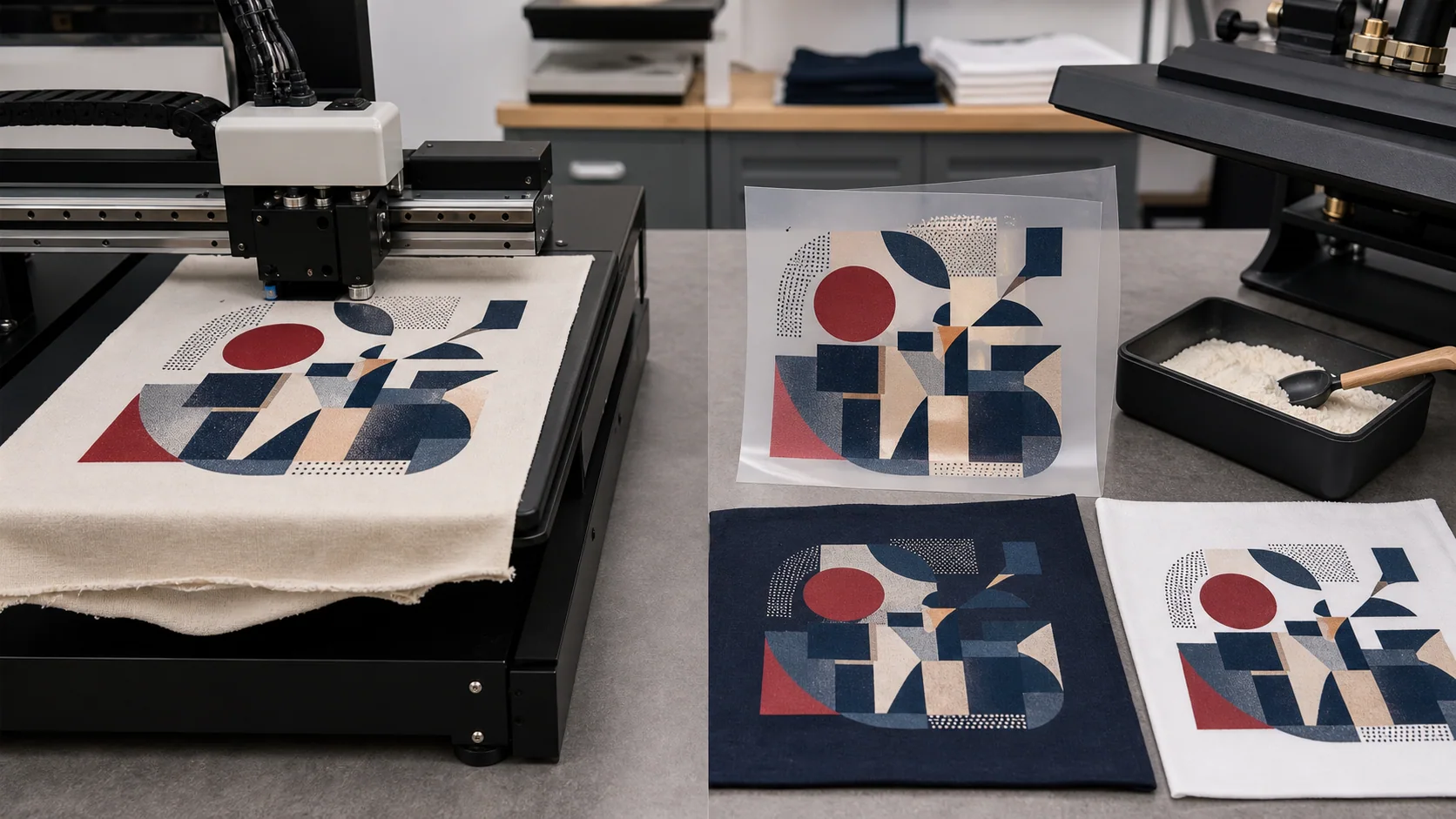
Generated explanatory visual, not SSM machinery, production, client, ink, material, or test proof.
The short answer
Start with DTG when the brief prioritizes direct printing on a compatible garment surface, detailed multicolor artwork, and a hand that must be reviewed within that ink and pretreatment system. Start with DTF when the brief needs a transfer workflow across a broader material program or difficult placement, while accepting that film, adhesive, heat, pressure, edge, and surface feel become part of the product. Then test the exact candidate. Do not confirm durability, softness, speed, price, or material compatibility from the process name alone.
Method boundary
This guide does not state that either method is performed internally for every project. SSM confirms the selected process, any qualified-partner boundary, available system, material compatibility, evidence, cost, and timing after reviewing the brief.
Compare the complete production system
The rows below are specification prompts. They are not universal performance rankings.
| Decision | DTG review | DTF review |
|---|---|---|
| Print path | Ink is jetted onto the prepared garment and cured as part of that substrate-specific workflow. | Artwork is printed onto transfer film, combined with an adhesive system, cured, and heat-applied to the garment. |
| Material decision | Commonly evaluated first on cotton and cotton-rich surfaces; exact ink and pretreatment compatibility must be confirmed. | Can support a broader material mix, but film, adhesive, heat, pressure, coating, dye, and stretch compatibility still require testing. |
| Surface and hand | The result is influenced by fiber, yarn, knit or weave, surface hair, pretreatment, white underbase, ink load, and cure. | The transfer creates a defined surface layer; coverage, film edge, adhesive, artwork density, fabric weight, and press settings affect hand and drape. |
| Artwork | Useful for detailed multicolor artwork where the prepared garment surface can hold the intended detail and tonal transition. | Useful for detailed or variable placements that can be arranged on film, subject to fine-line, adhesive, edge, and transfer limits. |
| Stretch and movement | Review ink and underbase behavior on the exact stretch direction, extension, recovery, seam location, and fit. | Review transfer formulation, artwork coverage, cracking, edge lift, recovery, pressure, and heat response on the exact garment. |
| Approval evidence | Retain the prepared substrate, artwork version, print settings, cure state, physical sample, care method, and result. | Retain film and adhesive system, artwork version, press settings, peel route, physical sample, care method, and result. |
Choose the method through five connected questions
1. What is the exact substrate?
Record fiber, construction, garment color, dye or wash, surface hair, coating, finish, weight, stretch, recovery, shrinkage, heat sensitivity, and the final decorated location.
2. What must the artwork do?
Record ownership, file version, physical size, placement, color reference, transparency, fine lines, gradients, white underbase, coverage, seam crossings, pockets, and size-grade behavior.
3. What hand and movement are acceptable?
Review touch, edge, drape, airflow, heat, moisture, stretch, recovery, cracking, lift, opacity, and comfort on the worn garment rather than a loose swatch alone.
4. What care and evidence are required?
Define the care method, test or inspection procedure, specimen, conditioning, acceptance criteria, result, date, reviewer, applicability, and limits before using a durability claim.
5. Can bulk reproduce the approved state?
Lock the garment, preparation, ink or transfer system, artwork, settings, color standard, placement, cure or press route, care, approved sample, inspection point, and change-control owner.
Physical approval gates
- 01Confirm the exact garment, fiber and construction, color, finish, stretch, wash state, artwork rights, placement, size range, quantity, and intended care.
- 02Select candidate method and system only after reviewing the printer, ink, pretreatment or film, adhesive, press, and production-ownership boundary.
- 03Approve a physical strike-off or decorated garment on the intended substrate, including hand, color, edge, opacity, stretch, placement, and reverse-side effect.
- 04Run the agreed care or durability review, record the method and result, then lock the approved artwork, process settings, garment state, and acceptable limits for bulk.
Failure modes to prevent
- A method is chosen from the artwork alone while fiber, surface, stretch, garment color, finish, and care are ignored.
- The sample uses a different blank, pretreatment, film, adhesive, press, cure, or wash state from the intended bulk product.
- A large solid print is approved flat without reviewing hand, drape, heat, moisture, stretch, and wearer comfort.
- Digital mockups substitute for a physical strike-off, or a supplier claim is repeated without identifying the tested specimen and conditions.
- Artwork scale and placement are fixed only in the base size and shift across graded garments, seams, pockets, or curved body zones.
What to put in the decoration brief
Send the garment specification and intended finished state; owned artwork and usage permission; vector master or suitable high-resolution raster; physical print dimensions; location measured from named garment points; color references; base garment colors; size range; quantity and colorway split; wash or finish sequence; stretch and hand requirements; care; target market; packaging; and the evidence or tests the buyer needs. Identify unknowns instead of hiding them inside a request for “the best print.”
Open the complete decoration guide Request a physical print review
Primary technical references
Manufacturer documentation describes particular systems, not every printer or SSM production route. It supports the process framework and must still be reconciled with the actual equipment, chemistry, substrate, and sample.
Brother Industrial Printing Current DTG and DTF system boundaries Epson pretreatment guidance Cotton and cotton-blend preparation context Epson hybrid DTG/DTFilm system Evidence that process capability is system-specific
Buyer questions
Is DTF always better for polyester and DTG always better for cotton?
No. Those are useful starting questions, not universal rules. Current printer systems, inks, pretreatments, films, adhesives, garment dyes, finishes, stretch, artwork coverage, press settings, and care can change the outcome. Approve the exact system on the intended garment.
Which method has the softer hand?
Hand depends on substrate, preparation, white underbase, ink or transfer coverage, artwork density, adhesive, cure, pressure, film edge, fabric weight, finish, and wash. Compare physical decorated samples rather than assuming a method label guarantees one feel.
Can the same artwork file be used for both methods?
The owned master artwork can be shared, but each production file may need different underbase, trapping, fine-line, transparency, color, edge, raster, size, and placement decisions. Keep the method-specific output version controlled.
How should durability be approved?
Agree the relevant care or test method, specimen, conditioning, cycle or exposure, acceptance criteria, reviewer, date, result, applicability, and limitation. A marketing wash-count claim without those details is not an approval record.
What are SSM's MOQ and timing?
SSM's confirmed MOQ is 50 pieces. Standard sample timing is 7-10 days and standard bulk production timing is 20-40 days after a workable brief and required inputs align. Decoration method, materials, artwork, testing, revisions, approvals, and production routing can affect the confirmed schedule.
Approve the decorated product, not a generic method.
Share the garment, artwork, placement, substrate, wash, care, quantity, timing, and open questions.