Custom Security Uniform Manufacturer: Shirts, Cargo Pants, and Hi-Vis Jackets
How buyers source custom security uniforms with role-based specs, durable construction, private label branding, and low-MOQ support from Pakistan.
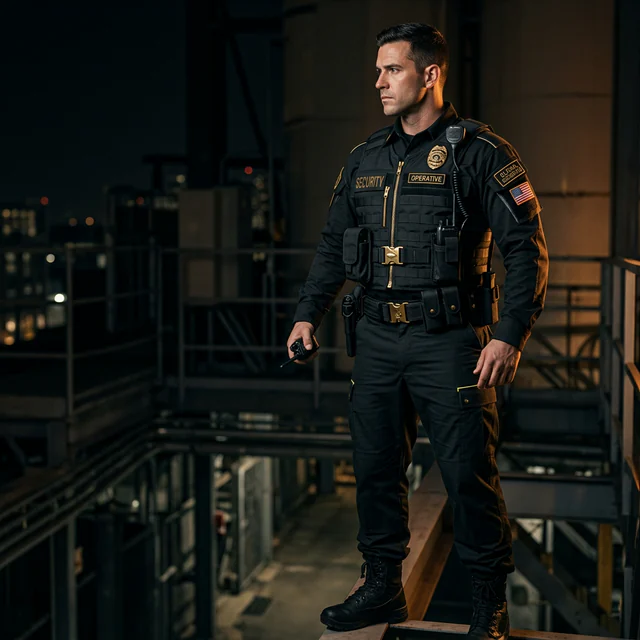
A security uniform should behave like a duty system, not a generic workwear bundle. Buyers need the shirt, trouser, and outer layer to match wearer movement, climate, branding, and visibility needs from the first sample round onward.
MOQ
50 pcs
Samples
7-10 days
Bulk
25-35 days
System
Shirt + pant + outerwear
Short Answer
A good security uniform manufacturer should help the buyer split the program by wearer role, confirm fabric and pocket logic, and control branding, wash durability, and replenishment planning before bulk starts. Buyers building a larger procurement program should pair this article with our corporate uniform RFQ template, the wash durability guide, and the downstream planning logic in annual replenishment planning.
The trouser side of a security program often overlaps directly with tactical-product development. If your cargo pant needs deeper utility storage, stronger reinforcement, or a more duty-focused fit block, review our custom tactical pants manufacturer guide and the technical bartack placement guide before approving bulk.
Buyer Checklist Before Sampling
- Split the program by wearer role instead of treating the whole uniform plan as one garment family.
- Define fabric composition, weight, and finish for shirts, pants, and outerwear separately.
- Specify whether hi-vis pieces are general-visibility garments or must match a named buyer standard.
- Approve movement-critical points like pocket access, belt compatibility, and knee bend before bulk.
- Plan 7-10 day samples around field use and wash testing, not only fit approval on a hanger.
What Needs to Be Defined Up Front?
| Program Area | What To Specify | Why It Matters |
|---|---|---|
| Shirts and polos | Pocket layout, pen slot, epaulets, badge loop, and fabric weight matched to duty profile. | A reception guard, control-room officer, and patrol team rarely need the same shirt construction. |
| Cargo pants | Rise, articulation, pocket placement, bartacks, and knee mobility should be reviewed during sampling. | Uniform pants fail fast when buyers approve appearance first and movement later. |
| Outerwear and hi-vis | Softshell, insulated outerwear, or hi-vis layers should be split by risk environment and climate. | Traffic-exposed roles, warehouse teams, and static gate staff often need different visibility and warmth logic. |
| Branding and packaging | Embroidery, woven badges, heat transfer, size stickers, and carton pack rules must be locked before costing. | Branding method and kit assembly often move both price and lead time. |
How the Strongest Security Programs Get Built
The strongest security uniform programs begin with operating context. A front-desk shirt, a mobile-patrol trouser, and a traffic-exposed jacket may share a brand identity but not the same construction brief.
Buyers should avoid asking the factory to guess the visibility requirement. OSHA notes that high-visibility garments are required in specific traffic-exposed circumstances, which is why the buyer should name the governing program standard and use case rather than saying only 'add hi-vis'.
Private-label security programs usually perform best when the first sample round locks the system: shirt, pant, outer layer, badge method, and packaging logic together. That reduces reorder friction later.
Current official safety guidance reinforces the point that visibility requirements should be named precisely. OSHA notes that high-visibility warning garments are required in specific traffic-exposed work situations, which is why buyers should define where the garment will be worn and which standard governs it rather than leaving that decision to guesswork. For broader procurement setup, also review our UAE corporate uniform sourcing checklist and the factory-side diligence in how buying houses audit a Pakistan factory. Buyers sourcing both worksite hi-vis and firearm-season visibility can consolidate onto one factory — see our wholesale blaze orange safety gear sourcing guide, which also covers the ANSI/ISEA 107 hi-vis build. OSHA guidance is a useful starting point for traffic-exposure discussions, but the buyer still needs to confirm the exact end-market requirement.
Quick Facts
What should a buyer brief first when sourcing security uniforms?
Start with wearer role, climate, duty profile, and branding method. Those choices affect pocket layout, fabric weight, outerwear need, and the right sample path more than the color alone.
Can security uniform programs start at a 50-piece MOQ?
Yes. A 50-piece MOQ works for pilot programs, department-level rollouts, distributor tests, and vendor qualification before a larger annual replenishment cycle begins.
How long does a custom security uniform sample usually take?
Where the technical file is clear, SSM can usually move first samples in 7-10 days and plan 25-35 day production after approvals, branding, and packaging are locked.
What is the most common mistake in security uniform sourcing?
Treating all wearer roles as one spec is the most common mistake. That usually leads to poor comfort, wrong pocket logic, or unnecessary cost in the wrong part of the program.
Need a Security Uniform Program Mapped Before Quoting?
Share the wearer roles, garment list, climate, branding method, and visibility requirement. SSM can map the sample path, private-label details, and export-ready production file before you commit to bulk.
Request Security Uniform Review Review Manufacturing Services