EU Textile Label Requirements for Apparel Sellers
How apparel sellers should handle EU textile labels: fibre composition rules, language requirements, component labeling, and supplier checkpoints.
If you sell apparel into the EU, the label is not a finishing detail you can leave until the last carton. Fibre composition, approved fibre names, language coverage, and attachment quality all affect whether the product is market-ready. This guide distills the core textile-label rules buyers and private-label sellers should check before the order leaves the factory.
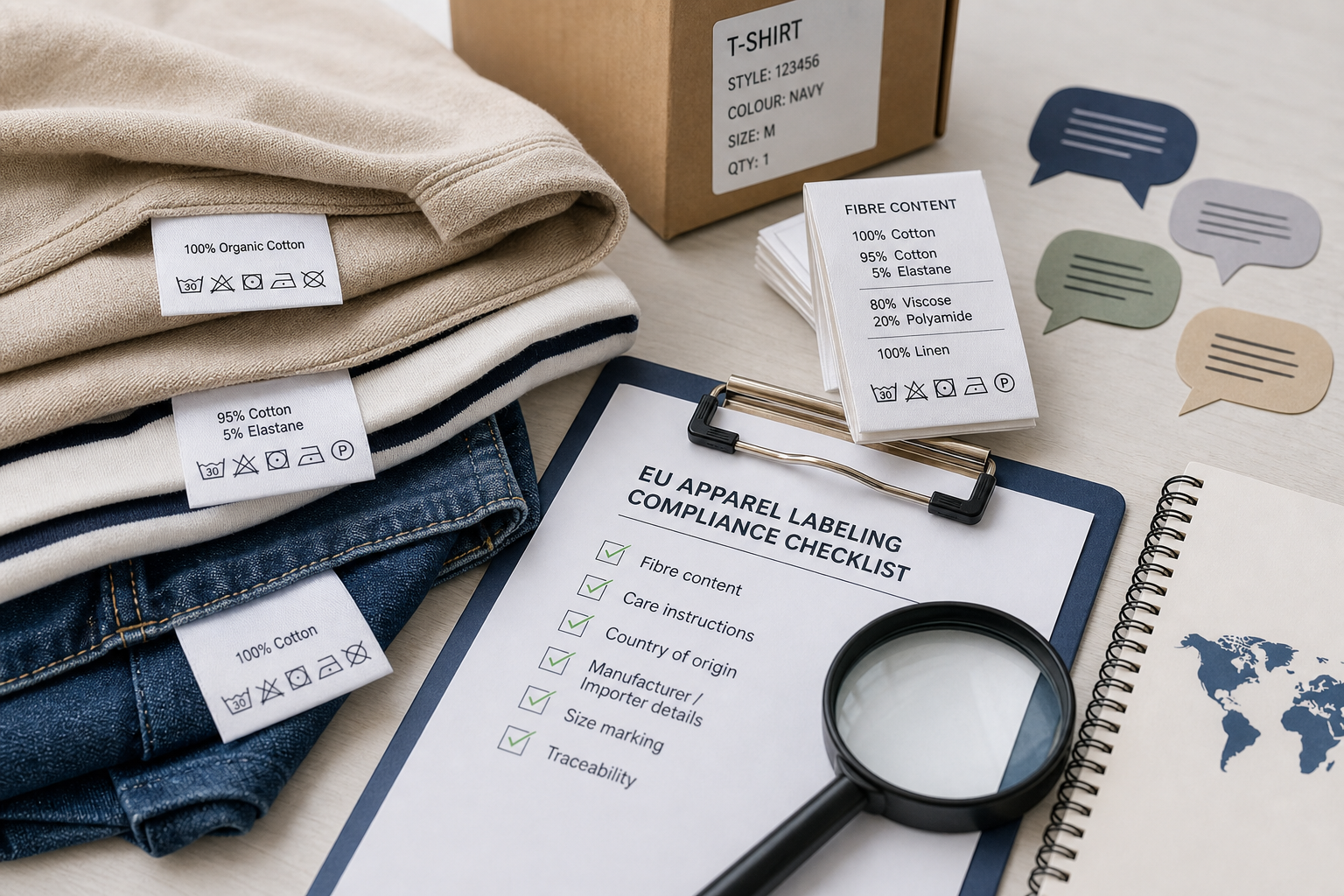
EU textile products sold to consumers generally need fibre-composition labeling under Regulation (EU) No 1007/2011.
The fibre names must match the approved EU list, and labels have to be durable, visible, legible, and accessible.
If the product is sold in multiple EU countries, the label text has to appear in the official language or languages required where the product is made available to consumers.
What the Current EU Baseline Actually Requires
The legal anchor is Regulation (EU) No 1007/2011, which governs textile fibre names and the labeling or marking of textile fibre composition. EU guidance for businesses also states that when you sell into one or more EU countries, the textile-label text must be translated into the official national language or languages where the product is made available to consumers.
That means a seller cannot treat one English-only label as a universal fix if the same product is going live in several EU markets. It also means supplier shorthand like "micro poly," "cool dry," or "performance blend" is not enough when the physical fibre declaration needs recognised names and percentages.
| Requirement | What To Do | Why It Matters |
|---|---|---|
| Fibre composition | Use the approved textile fibre names and percentages | This is the core requirement under Regulation (EU) No 1007/2011. |
| Language | Translate for the EU country or countries of sale | Member-state consumer-facing language requirements still apply at point of sale. |
| Label quality | Durable, visible, legible, accessible attachment | A label hidden, loose, or quickly unreadable is a practical compliance failure. |
| 100% / pure claims | Use only when the product is exclusively one fibre type | Those terms are restricted; misuse creates a labeling risk. |
| Component breakdown | List separate textile components when fibre composition differs | Mixed-component garments cannot always rely on one blended headline. |
Why 2026 Buyers Should Recheck Their Label Workflow
On 18 June 2026, a European Commission-supported testing campaign reported that 49 of 132 sampled clothing items had labels that did not correctly reflect the materials used. That is a current enforcement signal, not historical trivia.
For private-label sellers, the practical lesson is simple: do not let the final label artwork drift away from the actual BOM. If the mill changes the blend, the label must change. If lining, shell, or rib composition differ, review whether the component breakdown also needs to change. If the range expands into more EU countries, the language coverage has to be revisited before the next production run. And if the range leans on sustainability positioning, fibre accuracy is only step one — our guide to eco-friendly fabric sourcing for clothing startups covers the certification paperwork that keeps green claims defensible.
That is the same discipline behind our North American guides to U.S. apparel care labels and Canada textile labeling: label compliance is a product-development task, not a last-minute shipping task.
Factory-to-Seller Checklist
Lock the fibre composition in the BOM before the care label artwork is finalised.
Use only recognised EU fibre names instead of supplier shorthand or internal fabric nicknames.
Confirm which EU countries the product will be sold in and build the language set from that list.
Keep the care/fibre label attached in a durable way that survives normal handling and consumer use.
Check whether rib, lining, shell, or pocketing create component-level fibre declarations.
Review all packaging and product-page claims so they match the physical label exactly.
Retain supplier documents and sample approvals that support the final fibre declaration.
How Sialkot Sample Masters Helps Reduce Label Risk
Label Planning
We align label content with the approved garment BOM instead of treating it as a separate artwork task.
Market Awareness
Buyers can prepare multilingual label sets based on destination markets before packing starts.
Sample Control
Labels and trims can be reviewed during the sample stage alongside garment construction and fit.
Export Support
Private-label export workflows stay tighter when label, packaging, and shipping documentation are reviewed together.
This article is not legal advice, and EU market specifics can still vary by product context and selling setup. But it is a strong operational starting point for brands and buying teams who want to avoid obvious textile-label mistakes before the shipment is booked. If landed-cost planning is also part of the decision, pair this with our guide to FOB vs DDP for apparel importers.
Need Help Preparing EU-Bound Private-Label Orders?
Send your product spec, target EU markets, and current label draft. We can review the manufacturing side before bulk production starts.
EU Textile Label FAQs
Do apparel sellers need CE marking for ordinary clothing sold in the EU?
No. Ordinary clothing is not generally a CE-marked product category. The relevant issue here is textile fibre and consumer labeling compliance, not automatic CE marking.
What is the main EU rule for fibre labels on clothing?
The main rule is Regulation (EU) No 1007/2011 on textile fibre names and related labelling and marking of the fibre composition of textile products.
Do labels have to be translated for each EU country of sale?
In practice, yes where the products are made available to consumers. EU guidance says textile-label text must be translated into the official national language or languages of the markets where the product is sold.
Why should buyers re-check EU labels in 2026 instead of reusing an old format?
Because enforcement is active and recent. In June 2026, a European Commission-supported campaign reported incorrect material labeling on 49 of 132 sampled clothing items, showing that fibre-content accuracy is still a live compliance issue.