How to Compare Supplier Quotes Without Choosing the Cheapest Mistake
How apparel buyers should compare supplier quotes: normalize the spec, check Incoterms, score sample quality, and avoid the cheapest-price trap.
Apparel buyers rarely lose money because a spreadsheet was missing. They lose money because the spreadsheet looked complete while several suppliers were quoting different realities. One price assumes better fabric, another excludes labels, another hides freight behind FOB terms, and another looks cheap because the sample quality risk has not shown up yet. This guide is a practical framework for comparing quotes the way procurement teams should.
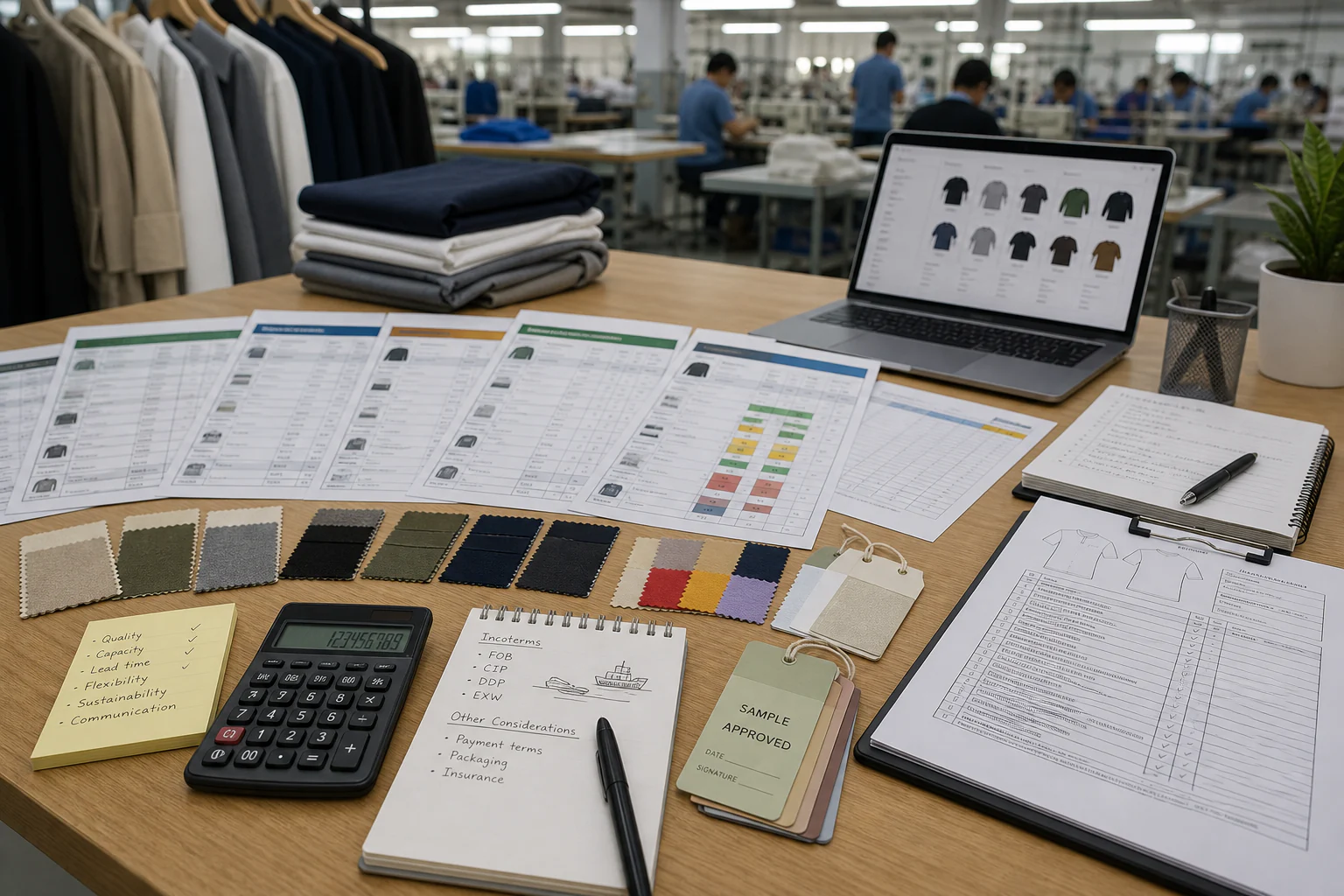
The cheapest garment quote is usually cheaper because something is missing: fabric spec, trim quality, packing scope, logistics responsibility, sample control, or defect risk.
Buyers should normalize quotes before comparing them by lining up the same fabric, decoration, packing, Incoterms, lead time, and QC assumptions across every supplier.
At Sialkot Sample Masters, the safest comparison model is cost plus operational risk: quote price, sample quality, communication speed, production visibility, and export readiness together.
Start by Normalizing the Quote, Not Ranking the Price
Most quote comparisons fail before the buyer even reaches the total. The suppliers are not pricing the same garment. One is using a lighter fabric, one is excluding neck labels, one assumes FOB, and one expects a simpler packing method. Ranking those numbers as if they describe the same product creates false clarity.
The safest first move is to rebuild every quote into one normalized sheet. Same fabric specification. Same measurement tolerance. Same decoration placements. Same packing rules. Same market-label expectations. Same Incoterm. Only after that does the number start to mean anything. Buyers who skip this step often end up learning the “cheap” quote was only cheap because it left work behind for someone else.
| Scorecard Factor | What To Compare | Weight |
|---|---|---|
| Fabric and trim match | Same GSM, same blend, same zipper/button/label scope? | High |
| Decoration scope | Same print, embroidery, twill, and personalization assumptions? | High |
| Packing and labeling | Polybag, barcode, carton ratio, private label, market labels included? | Medium |
| Incoterm and freight | EXW, FOB, CIF, or DDP? Taxes and last-mile included or not? | High |
| Sample and revision quality | How strong was the first sample and how quickly were comments handled? | High |
| QC and communication | Is there inline QC, final audit, and clear production visibility? | High |
Why the Cheapest Quote Gets Riskier in 2026
Current sourcing conditions reward control, not only price. QIMA’s 2026 sourcing survey continues to highlight cost pressure, tariffs, compliance, diversification, and supplier visibility as live issues across international sourcing networks. Procurement leadership reporting in 2026 also keeps ranking supplier relationships, resilience, and cost control together rather than treating unit price as a standalone win.
For an apparel buyer, the implication is straightforward: if one supplier is dramatically cheaper, you should assume there is an assumption gap until proven otherwise. The gap might be material. It might be lead time. It might be documentation. It might be the absence of proper inline QC. But it is rarely “free savings” by default.
This is also where Incoterms distort decision making. Our FOB vs DDP guide explains why a low FOB headline does not automatically beat a higher DDP number once customs, taxes, freight, and handling enter the real landed cost. Buyers that need a reusable evaluation tool after quote stage should pair that cost logic with an apparel supplier scorecard for buying houses so the comparison survives into production.
Eight Checks Before You Choose a Supplier
Rebuild every supplier quote into the same template before comparing unit prices.
Ask what was excluded from the quote instead of only asking what was included.
Check whether the quoted fabric is genuinely equivalent, not just similar by name.
Compare sample quality and revision discipline because rework is a hidden cost.
Review the Incoterm carefully; FOB and DDP numbers are not interchangeable.
Confirm whether labels, tags, folding, barcodes, and export cartons are priced in.
Score communication speed and clarity because poor communication usually turns into delay cost later.
Treat the cheapest quote as a risk signal until the supplier proves nothing critical is missing.
A Simple Comparison Framework Procurement Teams Can Reuse
| Step | Result |
|---|---|
| Normalize the spec | Same fabric, same measurements, same decoration, same packing assumptions across all suppliers |
| Compare landed scope | Know whether each quote is EXW, FOB, CIF, or DDP before judging price |
| Score sample performance | Track fit accuracy, construction cleanliness, and speed of revision handling |
| Review production risk | Check QC system, capacity realism, communication, and shipment planning |
| Decide on value | Choose the supplier with the best reliable total outcome, not only the lowest unit price |
Quote Discipline
Turn supplier quotes into one standardized structure before the commercial discussion starts.
Value Over Headline Price
A slightly higher price with better sample quality and cleaner execution can be the cheaper decision overall.
Risk Visibility
QC, documentation, and communication gaps should be scored like cost drivers, because they become cost later.
Landed-Cost Reality
A supplier is not “cheaper” until the full shipped and approved program is cheaper.
How Sialkot Sample Masters Supports Safer Quote Comparison
Sialkot Sample Masters is structured around the areas buyers usually struggle to normalize: low-MOQ sample-first development, clear trim and packing scope, QC visibility, and export support. That does not mean every buyer should choose one supplier blindly. It means the comparison becomes cleaner when the supplier is explicit about what is inside the number.
Buyers who are still at the vetting stage should also review our guide on what to look for in a clothing manufacturer and our buying-house apparel factory audit guide so the commercial comparison sits beside a proper operational review.
Need a Quote Reviewed Side by Side?
Send your current quote grid, target market, and garment spec. We can help identify where the price gap is real and where it is only hiding missing scope.
Review My Quotes See Production Services
Supplier Quote FAQs
Why is the cheapest apparel quote often risky?
Because quote gaps are common. One supplier may exclude labels, better trims, DDP shipping, or stricter QC, which makes the headline price look lower while moving the real cost elsewhere.
What should buyers compare before unit price?
Fabric and trim equivalence, decoration scope, sample quality, Incoterms, packing, lead time, and QC discipline all need to be aligned before unit cost becomes meaningful.
How do Incoterms distort quote comparisons?
A low FOB price can still land more expensively than a higher DDP price once freight, duties, taxes, customs, and last-mile handling are added. Buyers need to compare like with like.
What is a good minimum process before choosing a supplier?
Use one normalized scorecard, review samples, confirm packing and label scope, compare landed terms, and check how the supplier handles communication and revisions under pressure.